AKITSORA GAMING

Hanafuda Koi-Koi

Turn cards into yaku. Keep collecting. The final deal seeks Five Lights.

Hanafuda Koi-Koi deals 16 cards to form yaku. Five Lights opens collection: new yaku add deals and raise later multipliers, and an independent Five Lights seal can bring the round to 8,888× bet.

Demo play uses virtual credits with no monetary value.

RTP
96.51%
Volatility
Very high23.73
Max win
8,888× bet
Bonus buy
156.367× bet

In-game screens

Captured straight from the running game — real boards, real wins.

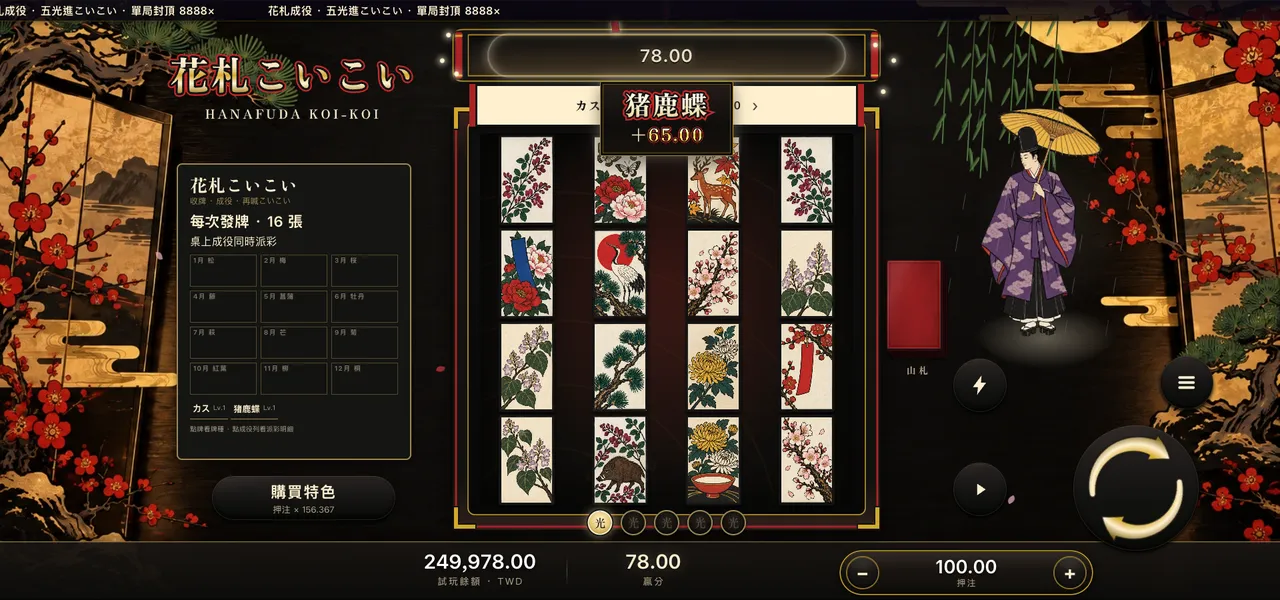
Hanafuda Koi-Koi — Base-game card board
Base-game card boardDeal 16 distinct cards without replacement from the complete deck and evaluate yaku.
Hanafuda Koi-Koi — Base-game yaku
Base-game yakuDifferent yaku can overlap. Lights award only their highest current tier.
Hanafuda Koi-Koi — Koi-koi collection
Koi-koi collectionDeal 8 cards; collect a month's cards only when at least 2 appear in that deal.
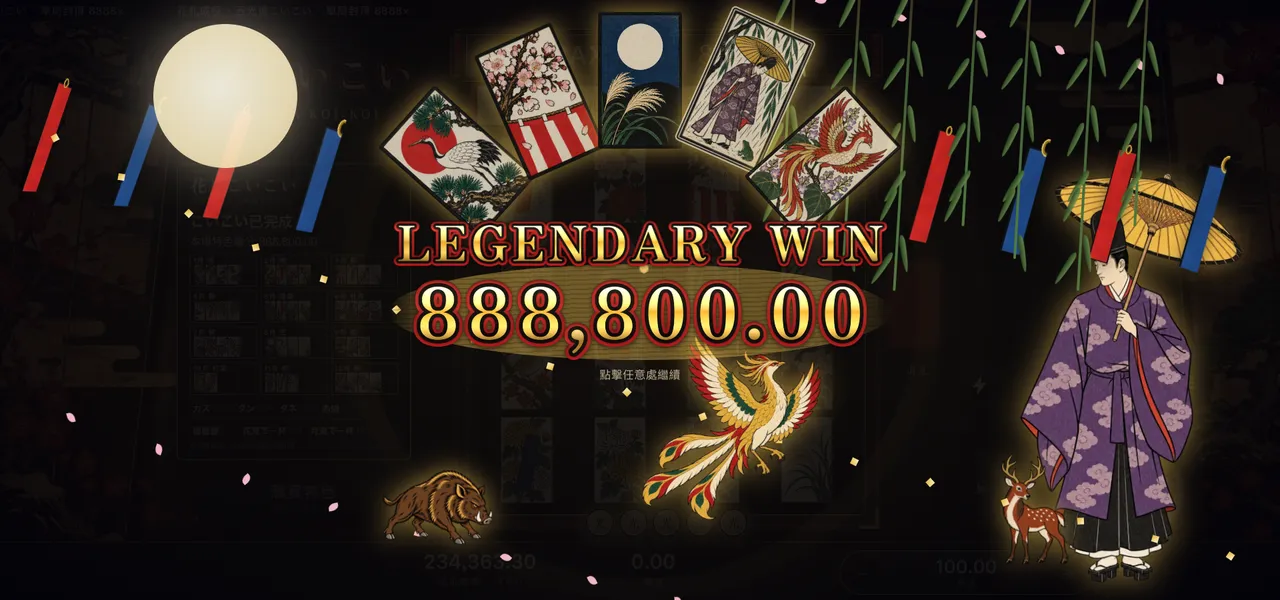
Hanafuda Koi-Koi — Big win
Big winA whole round, base game, collection and Five Lights seal combined, is capped at 8,888× the bet.
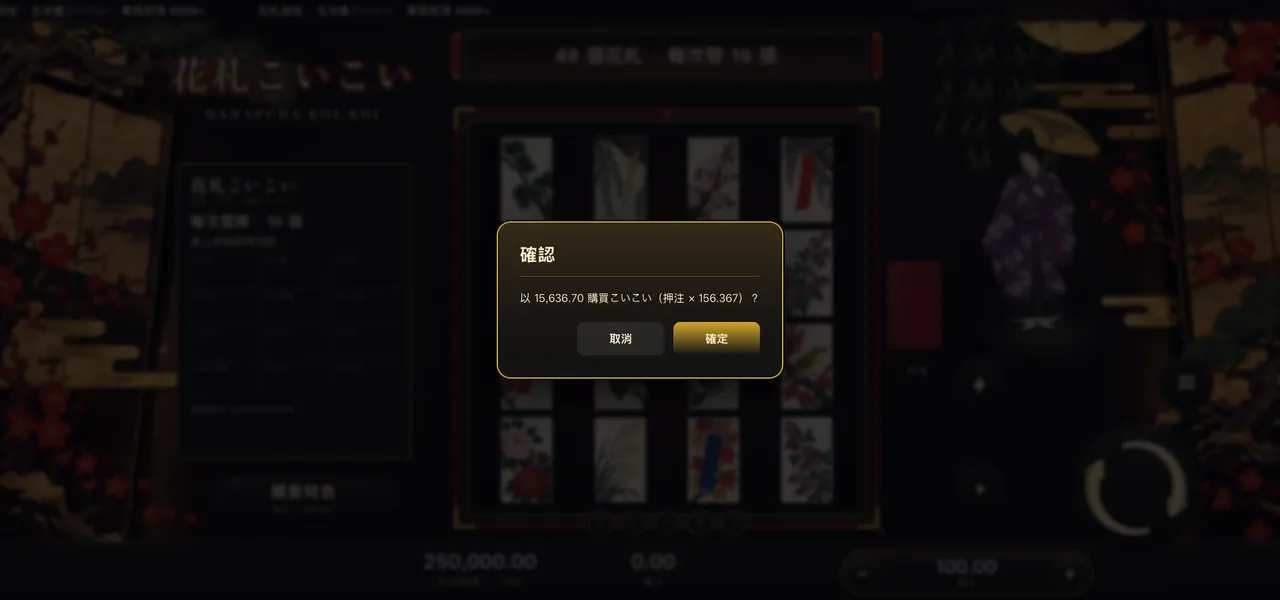
Hanafuda Koi-Koi — Buy koi-koi
Buy koi-koiPay 156.367× the bet for an empty collection, collection deals and the Five Lights seal.
Hanafuda Koi-Koi — In-game yaku table
In-game yaku tableFormation and payouts come from the same server-published rules as this page.
Hanafuda Koi-Koi — Collection and formed yaku
Collection and formed yakuInspect genuine collected cards by month. Duplicate cards add no count; upgrades do not add another extension.

Specification

Type4 × 4 base board; deals without replacement from 48 cards; yaku awards
Return to player (RTP)96.51%
Bonus buy RTP96.49%
VolatilityVery high (23.73)
Hit rate72.39%
Rounds winning ≥ 1× bet12.06%
Max win per round8,888× bet
Koi-koi collection and Five Lights seal frequency≈ 1 in 392.01 deals
RTP verificationExact base-game and Five Lights Seal expectations, with 10,000,000 independently sampled ordinary collection features; combined RTP has a 2σ margin of ±0.0079 percentage points. The sample count is features, not complete paid rounds.

Game math specifications and the paytable are read at build time from the definitions shared with the server code. See Math version for the configuration shown; confirm any other version or operator-specific settings separately.

How wins work

  • The deck contains 12 months of 4 cards, for 48 distinct cards. Every base deal reshuffles the complete deck and deals 16 cards without replacement to a 4 × 4 board. No card repeats within that deal.
  • Awards follow yaku: plain cards, ribbons, seed cards, poetry ribbons, blue ribbons, Ino-Shika-Cho, flower and moon viewing with sake, lights, and complete months. Position does not affect formation. This game adapts hanafuda into an independent single-player wagering game.
  • Different yaku can win together and may share cards. The chrysanthemum sake cup counts as both a seed card and a plain card. Lights pay only their highest tier; the paytable distinguishes combinations with and without the Rain Man.
  • All 5 light cards in a base deal open koi-koi collection. Five Lights has no separate base-game yaku payout; other formed yaku still pay. The natural feature occurs about once per 392.01 base deals, a long-run average rather than a countdown or guarantee.

Paytable

Values are total-bet multiples. Base play and collection use their own yaku tables. For plain cards, ribbons and seed cards, the value after '+' is the award increase per additional qualifying card. Different yaku can overlap; lights pay only the highest current tier. Base-game Five Lights triggers the feature without a separate Five Lights yaku award. A new collection yaku pays its full award; an upgrade pays only the unpaid difference in payout units. Each deal applies its opening multiplier, subject to the entire round cap.

YakuFormationBase gameCollection (×1)
Kasu — plain cards10+ plain cards; the chrysanthemum sake cup also counts. Each additional card upgrades the yaku.0.13× + 0.026×0.151× + 0.03×
Tan — ribbons5+ ribbons; each additional card upgrades the yaku.0.195× + 0.065×0.226× + 0.075×
Tane — seed cards5+ seed cards; the chrysanthemum sake cup also counts. Each additional card upgrades the yaku.0.26× + 0.078×0.301× + 0.09×
Akatan — poetry ribbonsAll poetry ribbons from pine, plum and cherry blossom.0.52×0.602×
Aotan — blue ribbonsAll blue ribbons from peony, chrysanthemum and maple.0.52×0.602×
Ino-Shika-ChoThe bush-clover boar, maple deer and peony butterflies.0.65×0.753×
Hanami de IppaiCherry-blossom curtain and chrysanthemum sake cup.0.39×0.451×
Tsukimi de IppaiPampas-grass moon and chrysanthemum sake cup.0.39×0.451×
Three Lights3 lights without the willow Rain Man, Ono no Tofu.2.6×3.01×
Rainy Four Lights4 lights including the willow Rain Man, Ono no Tofu.3.9×4.515×
Four Lights4 lights without the willow Rain Man, Ono no Tofu.6.5×7.526×
Five LightsAll 5 lights. Trigger only in the base game; this yaku pays within the collection feature.Feature trigger only15.034×
Complete monthAll 4 cards of a month; each month is evaluated separately.0.13×0.151×

Features

Koi-koi — collect matching months

Start with 10 collection deals. Each independently reshuffles all 48 cards and deals 8. A month contributes its cards only when at least 2 cards from that month appear in the current deal. Collection persists across deals; a previously collected card cannot increase the count. Base-game cards are not carried into collection.

New yaku — more deals

Each yaku's first formation pays an award and adds 2 deals. All light tiers share a family; each complete month has its own family. There are 21 families, each extending once, for at most 52 ordinary collection deals, followed by the seal.

Yaku upgrades — unpaid difference only

More plain, ribbon or seed cards, or a higher light tier, pay only the unpaid difference in payout units. Upgrading an existing yaku does not add another extension. The current deal's opening multiplier applies to its upgrade award.

Koi-koi multiplier — stronger later deals

Collection starts at ×1. Each first-time yaku doubles the multiplier for subsequent deals, up to ×8. Several new yaku in the same deal can advance it several steps. That deal's own awards retain the opening multiplier.

Five Lights seal — an independent final deal

After collection, reshuffle all 48 cards again and reveal 16 seal cards. This deal is independent of the collection. All 5 lights bring the entire round's accumulated win to 8,888× bet. Otherwise the seal adds nothing and preserves earlier wins. Seal cards neither join the collection nor form ordinary yaku or extend play.

Buy koi-koi

Pay 156.367× the bet to begin with an empty collection and 10 deals, including the final Five Lights seal. Natural play discloses 96.51% RTP and bonus buy 96.49%; the paths are verified separately. Buying the feature does not guarantee a profit.

Double-up — operator opt-in

Double-up is disabled by default and requires explicit operator activation. When enabled and eligible, the player can collect or attempt a double with a 50.00% win probability, at most 1 attempt. Only the feature win is at risk; base-game wins are protected. Losing sets the feature win to zero. The option appears only when the complete doubled award fits within the round cap, and never after a successful capped seal. Collect is the default and the recovery choice.

Collection, receipts and resume

Inspect collected cards by month and read the current deal's yaku, upgrade differences and multiplier in its receipt. Reconnecting restores the same round's collection, formed yaku, multiplier and actual remaining deals. The entire round is capped at 8,888× total bet.

Technical

Game codeaki_hanafuda
Math versionhnf1
TechnologyHTML5, no plug-in; one client for desktop and mobile
ViewportLandscape with proportional scaling
In-game languageTraditional Chinese (additional languages on request)
CurrenciesTWD (others can be registered on request)
IntegrationTransfer wallet (Operator API v3), launch-token redirect

Sources & verification scope

This product specification is written and maintained by its developer, Akitsora Gaming (AKI電子 in Taiwan). Measurement methods and sample information for RTP, volatility and hit rate appear in the specification table. Sampled results have uncertainty; RTP describes long-run return, not an individual player or session outcome.

Internal simulations and tests are not independent certification. We do not currently hold GLI or BMM certification reports. Supply to a market requiring third-party certification depends on completing its requirements.

See slot game development and supply for integration and supply scope, About us for development and content responsibility, or contact us for a math summary, version confirmation or a correction to this page.

The story

Fiction and adapted settings written by Akitsora Gaming for this title, including invented dialogue and events. This is not a historical or folklore reference. The rules and specification tables define the gameplay and math.

Golden clouds drift across black lacquer as the four seasons fall into place.
Call koi-koi to press the hand forward, then turn the final seal for Five Lights.

I. Twelve Months on Black Lacquer

In a quiet tatami room, warm lantern light gleams across a polished black lacquer table edged with painted gold clouds. A complete deck of traditional hanafuda unfolds the twelve months of the Japanese year—from January’s pine and crane to weeping plum blossoms in February, cherry curtains in spring, autumn maples, and December’s paulownia phoenix rising at year’s end. By the glow of the iron tea kettle, each lacquered card snaps cleanly onto the woven rush mat with crisp seasonal artistry.

Crisp woodblock contours preserve the poise of every flower and bird against the dark lacquered surface of the board. Plain kasu petals, crimson poetry and blue ribbons, lively animal seed cards, and gilded hikari light cards stand apart at a single glance, letting each freshly dealt hand reveal its seasonal harmony without a single repeated card on the table. From spring cherry blossoms to winter paulownia crests, the hand-painted deck turns every round in the parlor into a poetic duel.

II. Spirits of the Yaku

Victory in hanafuda belongs to the poetic combinations formed across the board regardless of where each card sits. When red poetry ribbons or blue ribbons align, or when the chrysanthemum sake cup joins the cherry-blossom curtain or the full harvest moon, classic hands like Hanami-de-Ippai and Tsukimi-de-Ippai come to life across the black lacquer table at once. By the glow of the iron tea kettle, each lacquered card snaps cleanly onto the woven rush mat with crisp seasonal artistry.

When the autumn bush-clover boar, maple stag, and peony butterflies gather together in a deal, Ino-Shika-Cho leaps straight off the cards—the boar charging forward, the deer lifting its antlers, and twin butterflies spreading their wings in symmetry—while the crane, phoenix, and umbrella-bearing Rain Man each stage their own Light card vignettes. From spring cherry blossoms to winter paulownia crests, the hand-painted deck turns every round in the parlor into a poetic duel.

III. Calling Koi-Koi to Collect

Should all five Light cards appear together in a single base deal, the quiet room echoes with the bold call of koi-koi and the multi-hand collection feature begins. Across a series of freshly shuffled deals, whenever enough cards from the same month land on the table together, those seasonal blooms are swept into your persistent collection tray. By the glow of the iron tea kettle, each lacquered card snaps cleanly onto the woven rush mat with crisp seasonal artistry.

Every time a new yaku family forms in the collection for the very first time, it pays its reward, grants extra collection deals, and doubles the multiplier for all subsequent hands in the round. Adding further cards to an existing yaku pays the newly earned difference in units, building quiet tension with each turn of the deck. From spring cherry blossoms to winter paulownia crests, the hand-painted deck turns every round in the parlor into a poetic duel.

IV. The Final Five Lights Seal

The true drama of koi-koi lies in the rhythm of pressing onward as the collection fills month by month and the multiplier climbs step by step. Once the final ordinary collection deal concludes, the gathered cards step aside and the entire deck is reshuffled from scratch for one last, independent reveal on the table: the Five Lights seal. By the glow of the iron tea kettle, each lacquered card snaps cleanly onto the woven rush mat with crisp seasonal artistry.

Unbound by the collection that came before, this closing hand turns face up on the black lacquer table with a single purpose as the entire room holds its breath. If all five Light cards shine together in that final deal, the entire round ascends straight to its maximum crown, sealing the night’s game in golden light. From spring cherry blossoms to winter paulownia crests, the hand-painted deck turns every round in the parlor into a poetic duel.

Want to spin Hanafuda Koi-Koi yourself?

The demo needs no account — click and spin. For integration docs, the math summary or sandbox access, send us an email.

Demo play uses virtual credits with no monetary value.