

AKITSORA GAMING

Tokaido Fifty-Three Stations

Yaji and Kita, all the way to Kyoto.

Tokaido Fifty-Three Stations is a 6×3, 729-ways slot. Two travellers fill whole reels as walking wilds; in the journey feature every step moves them down the Tokaido towards a Kyoto prize.

Demo play uses virtual credits with no monetary value.

RTP
96.73%
Volatility
High10.95
Max win
3,000× bet
Bonus buy
82.16× bet

In-game screens

Captured straight from the running game — real boards, real wins.

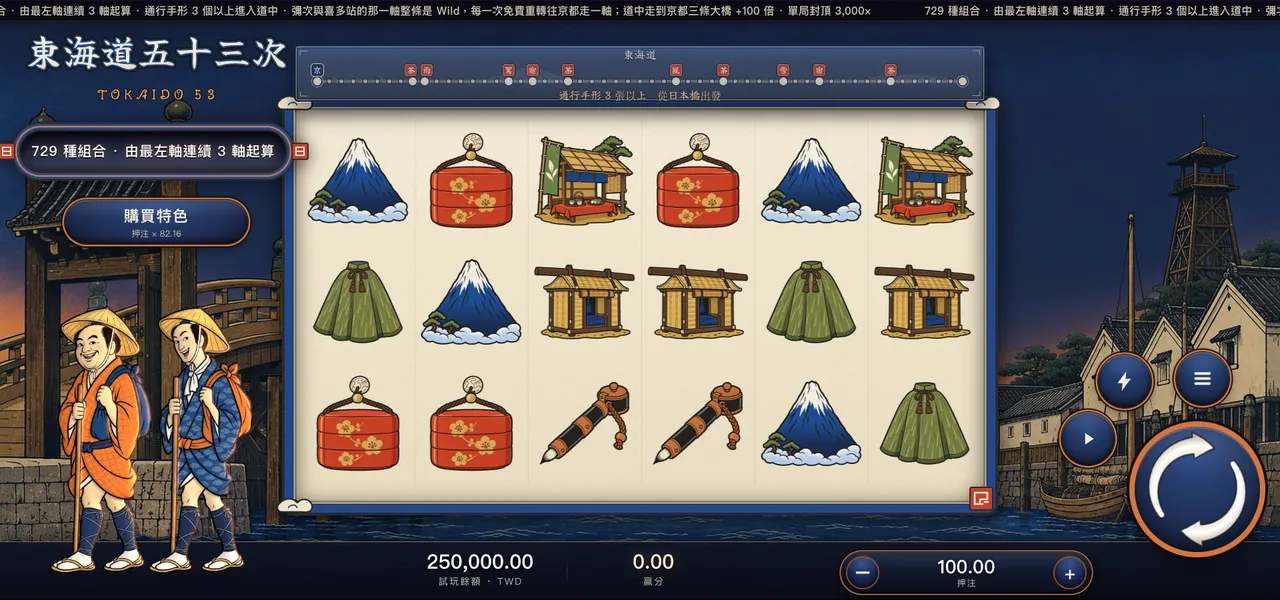
Tokaido Fifty-Three Stations — Base game
Base game6 reels × 3 rows, 729 ways. Yaji and Kita stand on the reels; the Tokaido route map runs above them.
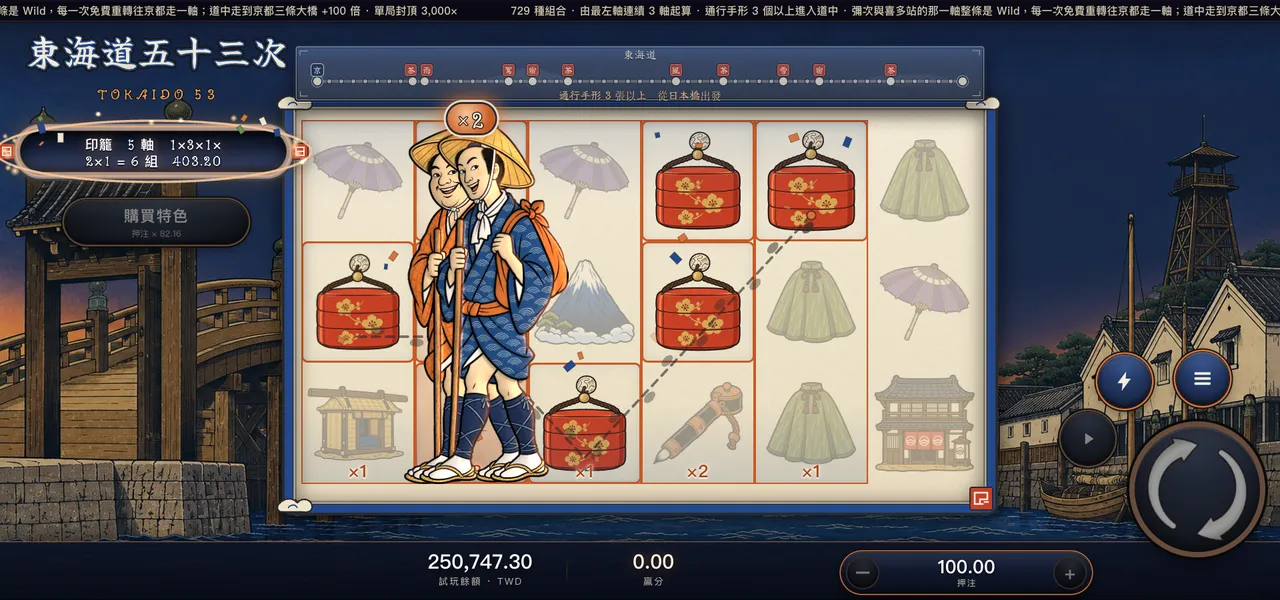
Tokaido Fifty-Three Stations — Travellers and a ways win
Travellers and a ways winA traveller's reel is wild from top to bottom and walks one reel left on every free respin; the capsule shows the symbol, the reels and the product of matches per reel.
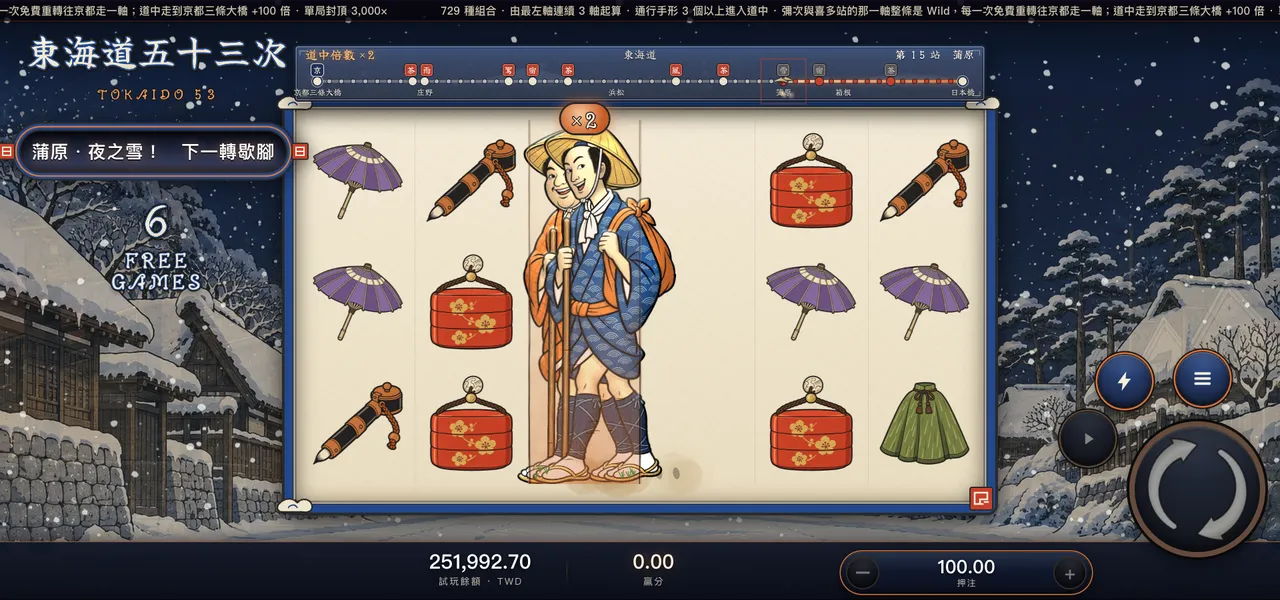
Tokaido Fifty-Three Stations — The journey
The journeyThe two walk side by side while the route map advances station by station; events and the journey multiplier show on the map.
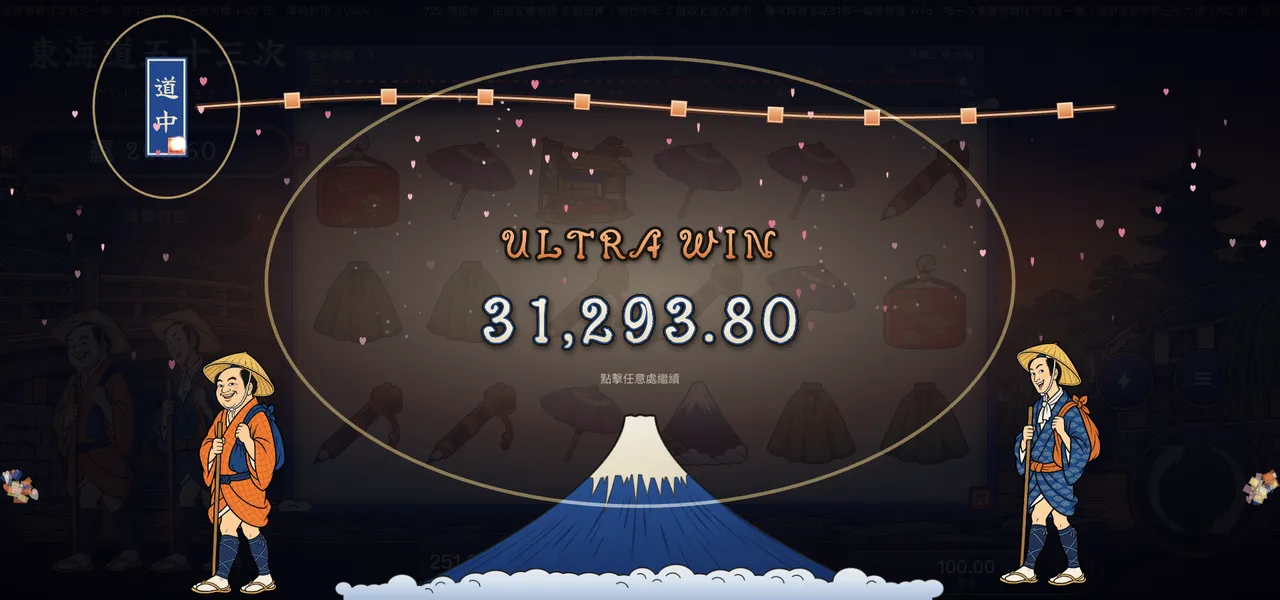
Tokaido Fifty-Three Stations — Big win
Big winCapped at 3,000× the bet per round.
Tokaido Fifty-Three Stations — Bonus buy
Bonus buyPay 82.16× the bet to start the journey directly.
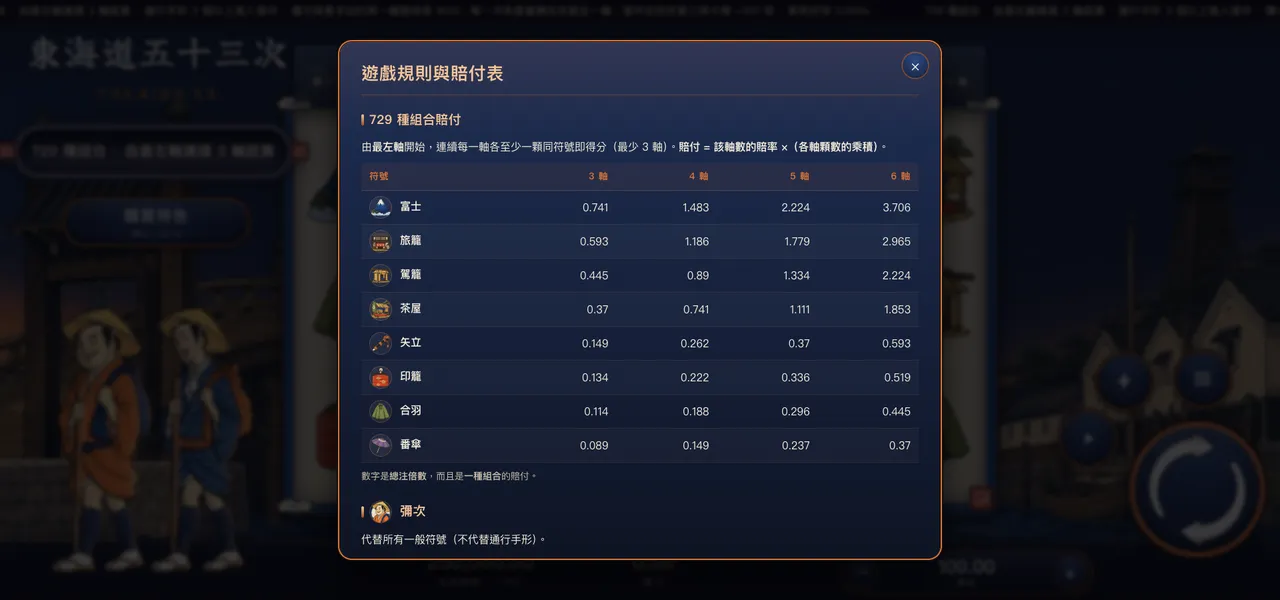
Tokaido Fifty-Three Stations — In-game paytable
In-game paytableThe same game definition as the table on this page: the game receives it from the server, and this page reads it at build time.

Specification

Type6 reels × 3 rows, ways (729 ways, 3+ consecutive reels from the left)
Return to player (RTP)96.73%
Bonus buy RTP96.73%
VolatilityHigh (10.95)
Hit rate36.21%
Rounds winning ≥ 1× bet7.93%
Max win per round3,000× bet
The journey (free spins) frequency≈ 1 in 161.01 spins
RTP verificationExact base game + 27,000,000 feature samples; combined RTP 96.7318%, 2σ margin ±0.0278 percentage points

Game math specifications and the paytable are read at build time from the definitions shared with the server code. See Math version for the configuration shown; confirm any other version or operator-specific settings separately.

How wins work

  • The grid is 6 reels × 3 rows with 729 ways and no paylines.
  • A win needs the same symbol (or a wild) on every reel in a row from the leftmost reel, at least 3 reels; the pay = table value × the product of matching symbols per reel.
  • A reel with a traveller (Yaji or Kita) on it is wild from top to bottom; when both share a reel, every cell of it counts ×2.
  • Travel passes count anywhere on the grid: 3 or more start the journey (free spins).

Paytable

Values are multiples of the total bet for one way: win = total bet × table value × the product of matching symbols on each reel (each cell of a shared reel counts ×2; times the journey multiplier during the feature). The same numbers as the in-game paytable.

Symbol3 reels4 reels5 reels6 reels
Mount FujiHigh-pay 0.7411.4832.2243.706
InnHigh-pay 0.5931.1861.7792.965
PalanquinHigh-pay 0.4450.891.3342.224
TeahouseHigh-pay 0.370.7411.1111.853
Brush caseLow-pay 0.1490.2620.370.593
InroLow-pay 0.1340.2220.3360.519
Rain capeLow-pay 0.1140.1880.2960.445
UmbrellaLow-pay 0.0890.1490.2370.37

Special symbols

Yaji and Kita

Wilds, on the right half of the grid only. Each fills its whole reel and walks one reel left on every free respin; a reel they share counts ×2.

Travel pass

Counts anywhere: 3/4/5 start 8/10/12 journey spins.

Features

Travellers — walking reel wilds

Yaji and Kita are wilds that land only on the right half of the grid. A traveller stands up and fills the whole reel, then walks one reel to the left on every free respin until he leaves the grid — the further right he lands, the more free respins he brings. If the same traveller lands on several reels at once, the rightmost one sets off and the others become the luggage he left behind (regular symbols).

Side by side

When both travellers stand on the same reel, each of its three cells counts ×2, and they walk on together.

The journey — fifty-three stations

3/4/5 travel passes start 8/10/12 journey spins. Yaji and Kita set off side by side from Nihonbashi (×2), and every step a traveller takes moves the route 2 stations. Stations hold events: teahouses (stations 6, 20, 33 and 46) add 2 spins, post towns (stations 12 and 36) add +1 to the journey multiplier, night snow (station 15) rests a spin, a tailwind (station 24) adds +1 to the journey multiplier, an express palanquin (station 38) jumps 2 more stations, and a white shower (station 45) washes the low symbols away. Every journey spin's ways win is multiplied by the journey multiplier.

Sanjo Bridge, Kyoto

The spin that reaches Kyoto adds 100× the bet, and from then on (that spin included) every ways win is ×2 more.

Volatility — positioning

Volatility 10.95. Hit rate 36.21% counts rounds with any win; 7.93% of all rounds return at least the stake. The base game carries about 47% of the RTP — travellers keep walking and keep bringing respins — and the journey arrives about once every 161.01 spins, with a longer tail the further it goes. This describes the product's positioning and does not guarantee session outcomes.

Bonus buy

Pay 82.16× the bet to start the journey directly (8 spins). The price comes from the expected value measured along the buy path (buy RTP 96.73%) and is calibrated separately from the base game.

Technical

Game codeaki_tokaido
Math versiontd1
TechnologyHTML5, no plug-in; one client for desktop and mobile
ViewportLandscape with proportional scaling
In-game languageTraditional Chinese (additional languages on request)
CurrenciesTWD (others can be registered on request)
IntegrationTransfer wallet (Operator API v3), launch-token redirect

Sources & verification scope

This product specification is written and maintained by its developer, Akitsora Gaming (AKI電子 in Taiwan). Measurement methods and sample information for RTP, volatility and hit rate appear in the specification table. Sampled results have uncertainty; RTP describes long-run return, not an individual player or session outcome.

Internal simulations and tests are not independent certification. We do not currently hold GLI or BMM certification reports. Supply to a market requiring third-party certification depends on completing its requirements.

See slot game development and supply for integration and supply scope, About us for development and content responsibility, or contact us for a math summary, version confirmation or a correction to this page.

The story

Fiction and adapted settings written by Akitsora Gaming for this title, including invented dialogue and events. This is not a historical or folklore reference. The rules and specification tables define the gameplay and math.

Morning mist lifts from Nihonbashi as Yaji and Kita set out along the highway.
Through mountain passes and sudden showers, fifty-three stations lead to Kyoto’s bridge.

I. Setting Out from Nihonbashi

Every great journey out of old Edo began at the timber arches of Nihonbashi in the early morning mist. Here two cheerfully hapless Edo townsmen—Yajirobei and Kitahachi—tie their woven straw sandals, hoist their cloth bundles onto their shoulders, and vow to walk the entire coastal highway all the way to the temples of Kyoto. Straw sandals kick up morning dust along the pine-lined highway as travelers trade stories between mountain passes and coastal bays.

Immortalized in Jippensha Ikku’s classic comic novel Tokaidochu Hizakurige, the pair travel on foot by “shank’s mare,” stumbling from one roadside misadventure to the next at every post town—sampling local delicacies, tipping too many cups of warm sake, and leaving far more laughter than footprints along the busy road. Woodblock-inspired vistas of Mount Fuji and post-town inns frame every stride of the historic journey from Edo to Kyoto.

II. Prints of Fifty-Three Stations

Stretching between Edo and the imperial capital lay fifty-three post stations where weary travelers rested and changed horses. Master printmaker Utagawa Hiroshige captured every stop in his celebrated woodblock series: coastal dawn at Shinagawa, steep crags at Hakone, silent night snow at Kambara, and driving white rain bending the bamboo at Shono. Straw sandals kick up morning dust along the pine-lined highway as travelers trade stories between mountain passes and coastal bays.

Across this five-reel, three-row all-ways grid, snow-capped Mount Fuji, timbered inns, express palanquins, and roadside teahouses spin alongside the travelers’ portable brush cases, lacquer inro, straw rain capes, and oiled paper umbrellas, all rendered in crisp ukiyo-e woodblock lines beneath a hand-brushed Bokashi sky. Woodblock-inspired vistas of Mount Fuji and post-town inns frame every stride of the historic journey from Edo to Kyoto.

III. Walking Wilds Heading West

Whenever Yaji or Kita lands on the right half of the board, the traveler stands tall to fill the entire reel as a Wild, then strides one column leftward on each consecutive free respin until he walks off the western edge of the screen—bringing more free respins the further right his journey begins. Straw sandals kick up morning dust along the pine-lined highway as travelers trade stories between mountain passes and coastal bays.

Should both companions land on the very same column at once, they travel side by side: every cell on their shared reel carries a boosted pair multiplier as they march across the board together, turning a chance meeting on the Tokaido road into a rich windfall of ways combinations. Woodblock-inspired vistas of Mount Fuji and post-town inns frame every stride of the historic journey from Edo to Kyoto.

IV. Arrival at Sanjo Bridge in Kyoto

Gathering enough wooden Travel Pass scatters opens the barrier gate for the Fifty-Three Stations journey feature. Setting off side by side from Nihonbashi, every step a traveler takes advances the route map across famous stations—stopping at teahouses for extra spins, post towns and tailwinds to raise the journey multiplier, express palanquins to leap ahead, and sudden showers that wash low symbols from the reels.

The moment their footsteps reach Sanjo Bridge in Kyoto, an instant arrival prize is awarded and every ways win for the rest of the journey is multiplied again by the Kyoto goal multiplier. Leaping high to slap hands on the wooden bridge, the two old friends turn a long road into a grand finale. Woodblock-inspired vistas of Mount Fuji and post-town inns frame every stride of the historic journey from Edo to Kyoto.

Want to spin Tokaido Fifty-Three Stations yourself?

The demo needs no account — click and spin. For integration docs, the math summary or sandbox access, send us an email.

Demo play uses virtual credits with no monetary value.