AKITSORA GAMING

Kaiju Studio

Action! Every model the monster stomps hides a surprise.

Kaiju Studio is a 7×5 cluster cascade on a model-city film set: wins smash the buildings next to them, wrecked models reveal multipliers, explosives and monster moves.

Demo play uses virtual credits with no monetary value.

RTP
96.39%
Volatility
Very high34.03
Max win
25,000× bet
Bonus buy
132.52 / 312.62× bet

In-game screens

Captured straight from the running game — real boards, real wins.

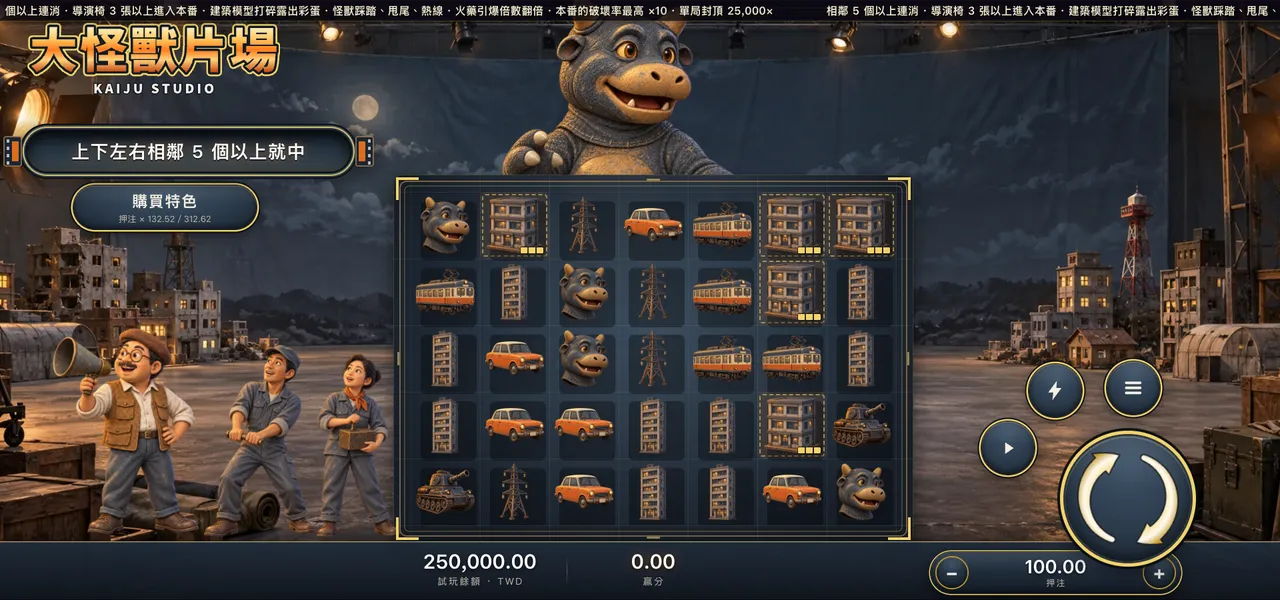
Kaiju Studio — The model city
The model cityA 7×5 model city, an actor in a monster suit behind it and the director with a megaphone in the corner.
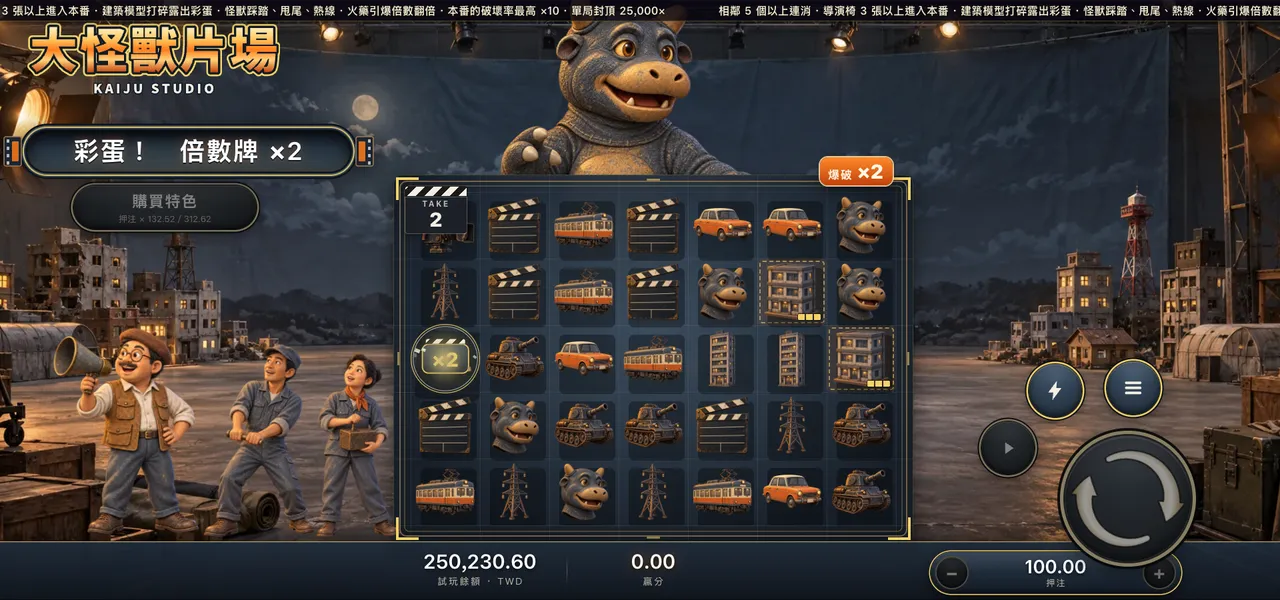
Kaiju Studio — Smashing the models
Smashing the modelsWins knock layers off the buildings next to them; the last layer reveals a surprise.
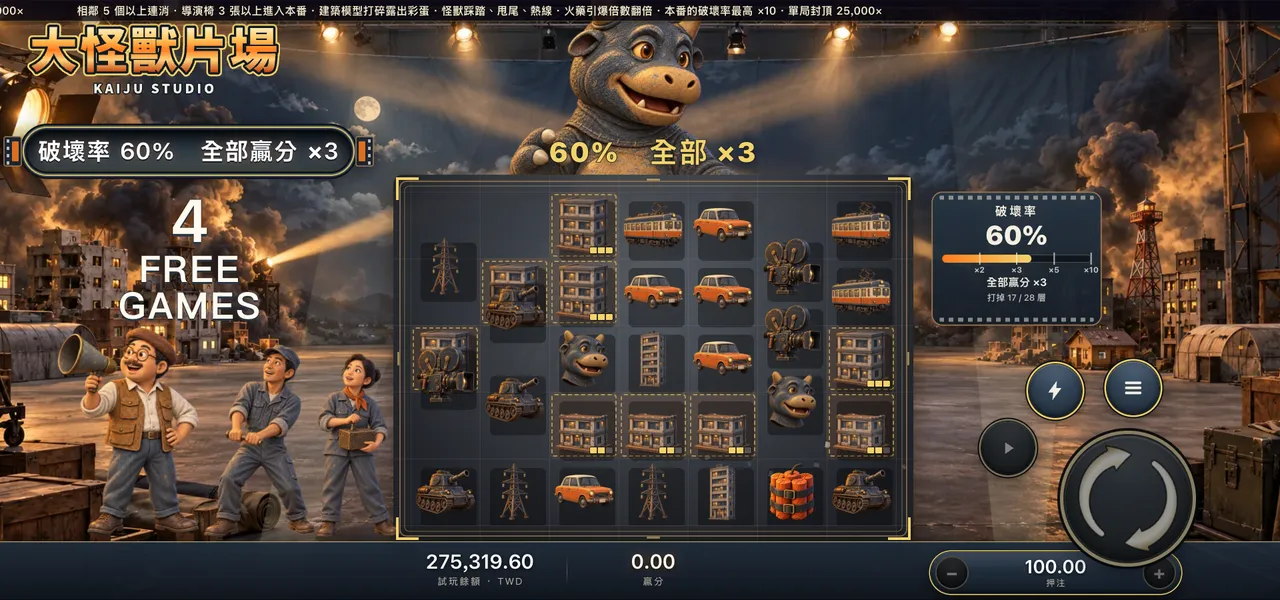
Kaiju Studio — The Take
The TakeThe monster strikes every spin; the more it wrecks, the bigger the multiplier, up to ×10.
Kaiju Studio — Big win
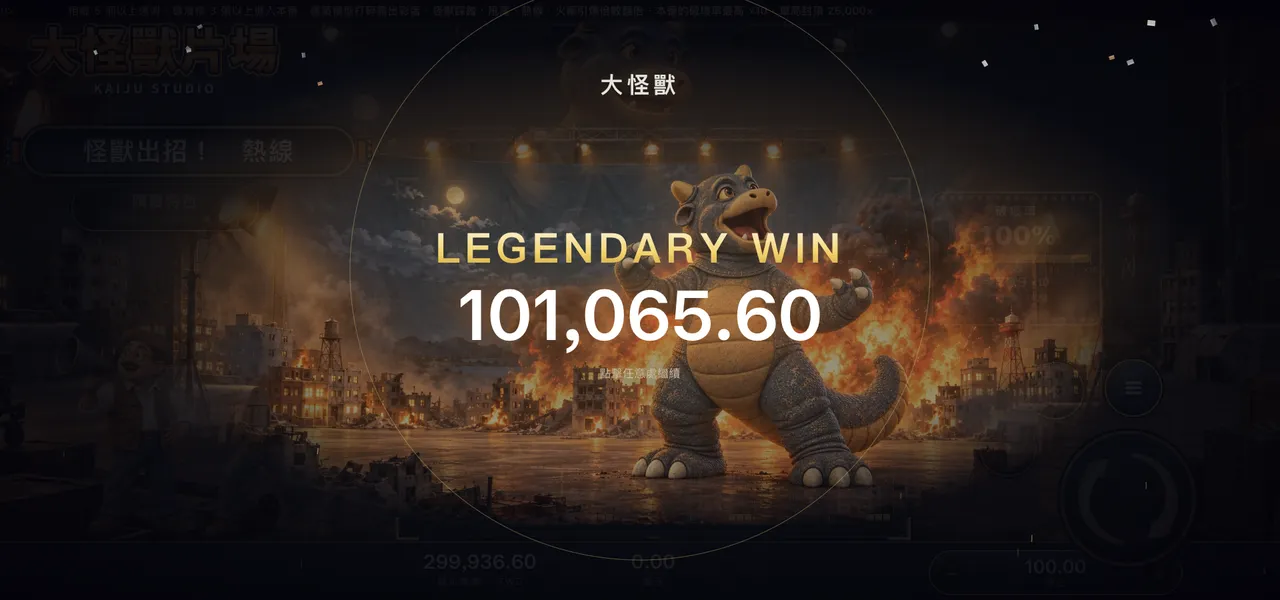
Big winA single round is capped at 25,000× the bet.
Kaiju Studio — Bonus buy
Bonus buyTwo tiers: 132.52× into The Take, 312.62× with the meter at 50%.
Kaiju Studio — In-game paytable
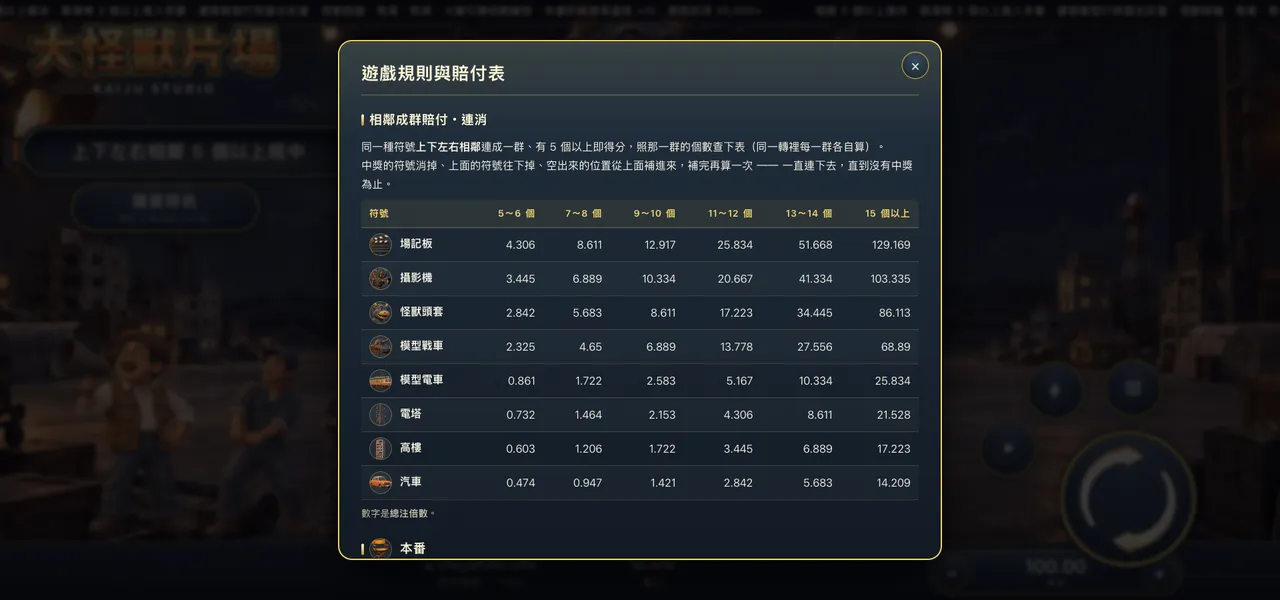
In-game paytableFrom the same game definition as this page: served by the RGS in game, read at build time here.

Specification

Type7×5 cluster pays with cascades (5+ touching up, down, left or right; model buildings stay put)
Return to player (RTP)96.39%
Bonus buy RTP (The Take)96.39%
Bonus buy RTP (The Take — roll at higher destruction)96.39%
VolatilityVery high (34.03)
Hit rate23.33%
Rounds winning ≥ 1× bet9.99%
Max win per round25,000× bet
The Take (free spins) frequency≈ 1 in 268.72 spins
Calibration sample4,000,000,032 spins, standard error 0.02%

Game math specifications and the paytable are read at build time from the definitions shared with the server code. See Math version for the configuration shown; confirm any other version or operator-specific settings separately.

How wins work

  • The grid is a 7×5 model city with no paylines: one symbol touching up, down, left or right forms a cluster, and 5 or more pay by count.
  • Winning symbols are removed, the rest fall and new ones drop in from the top, then the grid pays again — until nothing wins.
  • Model buildings take up cells, never pay and never fall (other symbols drop past them). Each base-game spin builds 3~6 of them, 3 layers each.
  • Director's chairs do not pay: 3 or more on the grid once the cascades stop start The Take (free spins).

Paytable

Values are multiples of the total bet per cluster: win = total bet × table value × that cascade's multiplier (the explosion multiplier, times the destruction multiplier in the bonus), and at the end of the spin × the sum of the multiplier cards on the grid (looked up by the number of one symbol in the cluster; explosives connect but do not count).

Symbol5–67–89–1011–1213–1415+
ClapperboardHigh-pay 4.3068.61112.91725.83451.668129.169
Film cameraHigh-pay 3.4456.88910.33420.66741.334103.335
Monster headHigh-pay 2.8425.6838.61117.22334.44586.113
Model tankHigh-pay 2.3254.656.88913.77827.55668.89
Model trainLow-pay 0.8611.7222.5835.16710.33425.834
PylonLow-pay 0.7321.4642.1534.3068.61121.528
Tower blockLow-pay 0.6031.2061.7223.4456.88917.223
CarLow-pay 0.4740.9471.4212.8425.68314.209

Special symbols

Explosive

Wild; substitutes for any regular symbol (not the director's chair), blows up the cells around it when it wins and doubles the multiplier.

Director's chair

Scatter, does not pay. 3 or more on the grid once the cascades stop start The Take.

Features

Model buildings and surprises

Every winning cell knocks a layer off each building next to it. When the last of the 3 layers goes, a surprise is revealed: a multiplier card (×2/×3/×5/×10; it stays and falls with the grid, and all cards are added up and applied at the end of the spin), an explosive, or a monster move.

Monster moves

Stomp crushes a whole column, Tail sweeps a whole row, Ray burns a diagonal: regular symbols in range are blown away and buildings lose a layer. Moves come out of wrecked buildings, and in the base game the monster sometimes strikes on its own as the reels stop.

Explosives and the explosion multiplier

The explosive substitutes for any regular symbol in a cluster (without counting). When it wins it blows up the 3×3 around it — symbols in range are removed and buildings lose a layer — and every explosion doubles the multiplier for the rest of the spin (up to ×32 in the base game, ×8 in the bonus).

The Take and the destruction meter

3/4/5 director's chairs award 10/12/15 spins of The Take. Each spin builds 8~12 buildings and the monster strikes every spin; every layer knocked off fills the destruction meter, and at 25%/50%/75%/100% every cascade is multiplied by ×2/×3/×5/×10 for the rest of the bonus. At 100% it is a wrap: 5 more spins, and explosions stop resetting each spin. There are no chairs in The Take (no retriggers).

Volatility and positioning

Volatility 34.03. The 23.33% hit rate counts any winning round; 9.99% of all rounds return at least the stake. Cascades, surprises and explosions carry about 49% of the RTP in the base game; The Take comes about once every 268.72 spins, with a meter that keeps building and a long tail. A single round is capped at 25,000× the bet and ends when it hits the cap. This describes the product's positioning and does not guarantee any single session.

Bonus buy

Pay 132.52× the bet to start The Take (10 spins), or 312.62× to start with the destruction meter at 50%. Each price follows the expected value of its purchase route (bonus-buy RTP 96.39% and 96.39%) and is calibrated separately from regular play.

Technical

Game codeaki_kaiju
Math versionkj1
TechnologyHTML5, no plug-in; one client for desktop and mobile
ViewportLandscape with proportional scaling
In-game languageTraditional Chinese (additional languages on request)
CurrenciesTWD (others can be registered on request)
IntegrationTransfer wallet (Operator API v3), launch-token redirect

Sources & verification scope

This product specification is written and maintained by its developer, Akitsora Gaming (AKI電子 in Taiwan). Measurement methods and sample information for RTP, volatility and hit rate appear in the specification table. Sampled results have uncertainty; RTP describes long-run return, not an individual player or session outcome.

Internal simulations and tests are not independent certification. We do not currently hold GLI or BMM certification reports. Supply to a market requiring third-party certification depends on completing its requirements.

See slot game development and supply for integration and supply scope, About us for development and content responsibility, or contact us for a math summary, version confirmation or a correction to this page.

The story

Fiction and adapted settings written by Akitsora Gaming for this title, including invented dialogue and events. This is not a historical or folklore reference. The rules and specification tables define the gameplay and math.

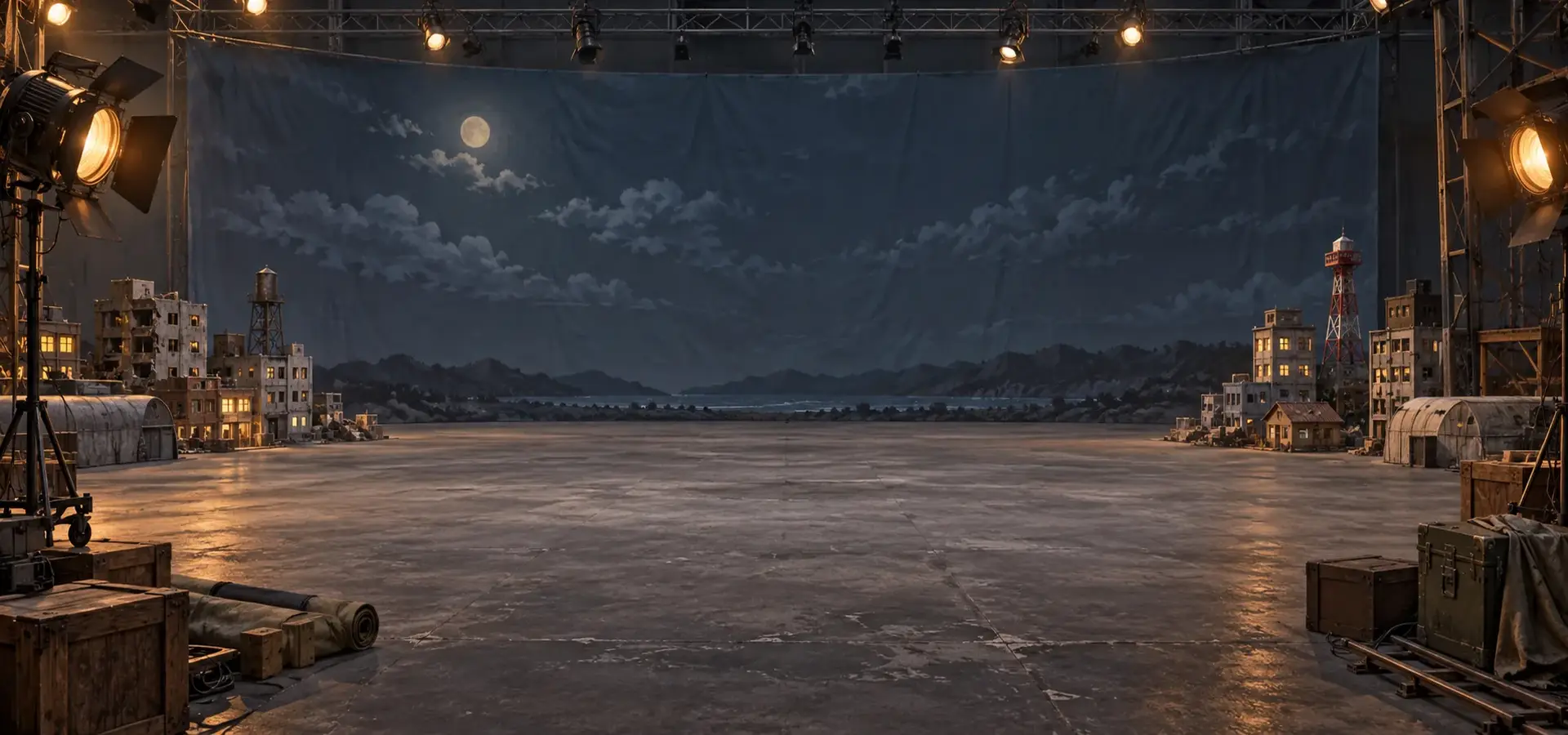
The entire metropolis on the sound stage stands barely knee-high.
Yet the moment the clapperboard snaps and the camera rolls, the monster is larger than life.

I. A Miniature Metropolis on the Sound Stage

Step through the heavy iron doors of a Shōwa-era special-effects studio and you find a plaster-and-balsa city built entirely by hand over months of painstaking craft: miniature tower blocks, steel pylons, tiny model trains, parked cars, and a defensive line of olive-drab model tanks waiting along the boulevard.

On the grid, multi-layered model buildings stand fixed in place while other symbols cascade behind them from the studio rafters. Overhead lamps blaze to life, the effects crew retreats behind the painted sky backdrop, and the director rises from his canvas director's chair with megaphone in hand.

II. Rubber Suits, Monster Moves, and Surprises

Waiting at the edge of the skyline is the suit actor, sweating inside a heavy latex costume topped with a fierce monster head. The instant the clapperboard snaps before the rolling film camera, he becomes the titan—unleashing a column-crushing Stomp, a row-sweeping Tail lash, or a diagonal Ray of atomic fire!

Every adjacent winning cluster—and every monster attack—knocks a storey off the model buildings. Smash all three layers and the wreckage reveals a hidden studio prop: a multiplier card that falls with the grid and tallies at the end of the spin, a fresh monster move, or a wired explosive charge.

III. Pyrotechnics on the Rooftops

No tokusatsu spectacle is complete without practical pyrotechnics tucked under the miniature eaves. The explosive symbol acts as a wild that joins any neighbouring cluster; the moment it takes part in a win, the effects technician hits the plunger and blasts the surrounding square of cells!

Each detonation clears the regular symbols in range, strips another layer from nearby buildings, and doubles the explosion multiplier for every cascade that follows in that spin. Bright sparks shower across the miniature streets as new symbols tumble into the craters from above.

IV. Rolling the Main Take to the Final Wrap

Gather enough director's chairs once the cascades settle and the red studio light flashes for The Take. During these free spins, the prop crew erects fresh buildings on every round while the monster strikes without fail on every spin, filling the studio's overall destruction meter to raise the persistent stage multiplier.

Flatten enough of the city to fill the meter completely and the director calls a triumphant wrap—adding bonus spins where the explosion multiplier no longer resets between rounds. This behind-the-scenes tribute is the game's theme rather than a promise: every spin's outcome is decided solely by the server's random number generator.

Want to spin Kaiju Studio yourself?

The demo needs no account — click and spin. For integration docs, the math summary or sandbox access, send us an email.

Demo play uses virtual credits with no monetary value.