AKITSORA GAMING

Daruma Wish

Fall seven times, rise eight.

Daruma Wish is a 3×3, 5-line slot. 2+ darumas trigger sticky respins; a brush paints the second eye on neighbouring darumas, and more open eyes mean a bigger multiplier.

Demo play uses virtual credits with no monetary value.

RTP
96.82%
Volatility
Medium4.89
Max win
2,500× bet

In-game screens

Captured straight from the running game — real boards, real wins.

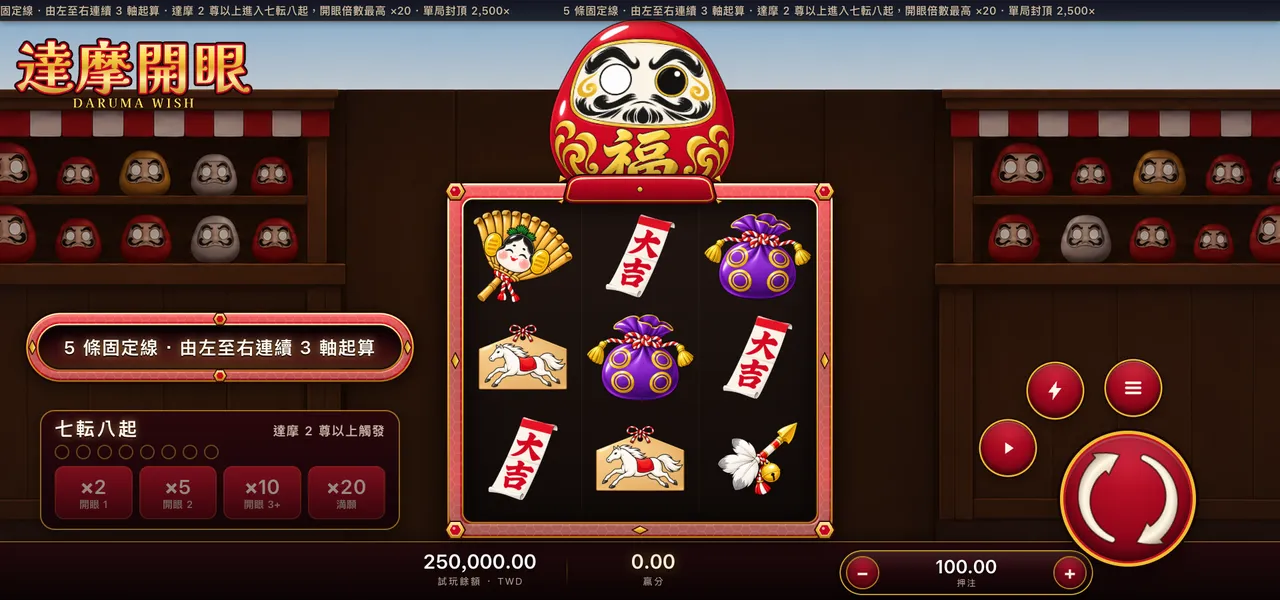
Daruma Wish — Base game
Base game3 reels × 3 rows, 5 fixed lines; a giant daruma sits right above the reels.
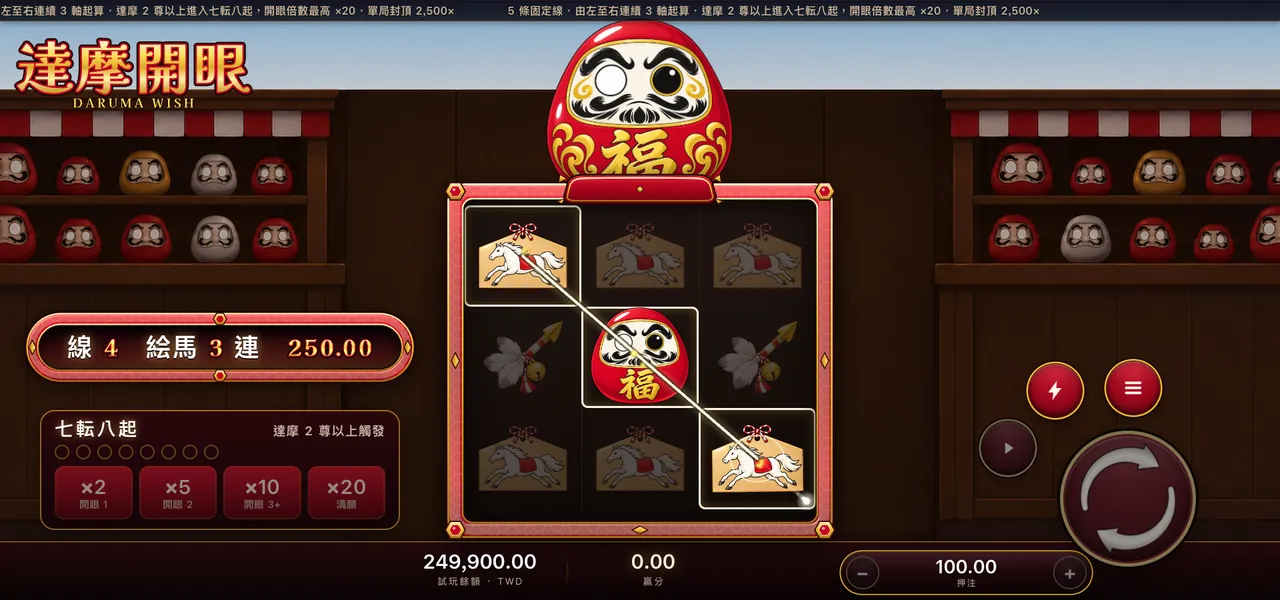
Daruma Wish — A line win
A line win3 of the same symbol on a line wins; darumas substitute for every regular symbol.
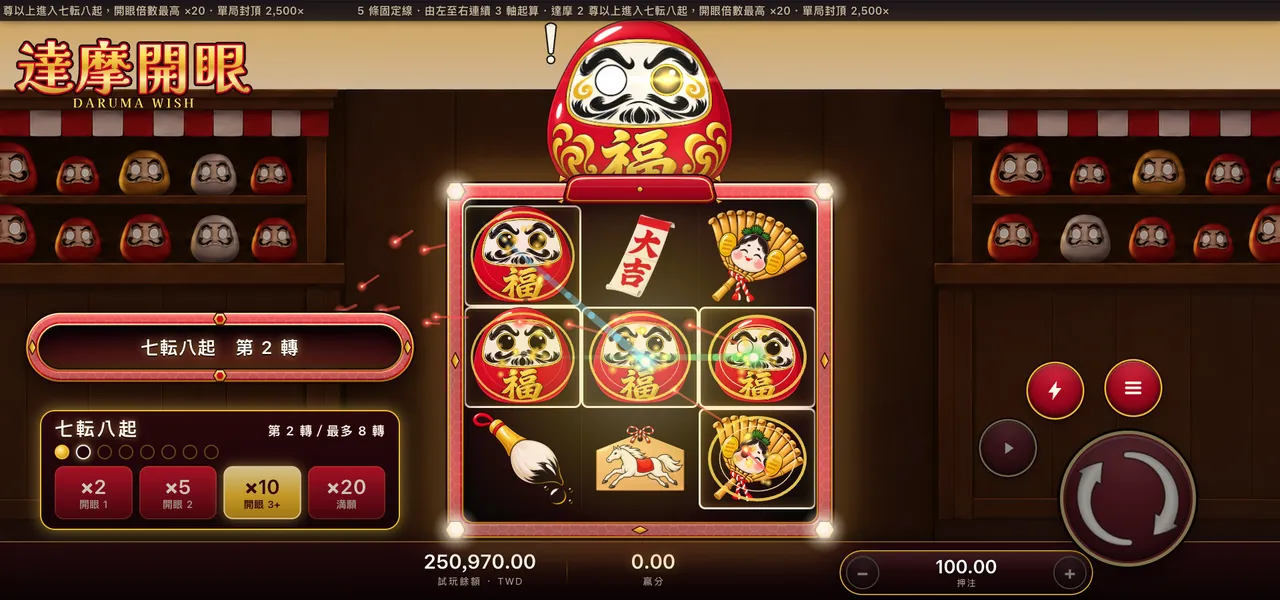
Daruma Wish — Nanakorobi Yaoki
Nanakorobi YaokiDarumas stick while the other cells respin; the panel at the lower left shows the respins and the eye-multiplier ladder.
Daruma Wish — Big win
Big winCapped at 2,500× the bet per round (Mangan Joju).
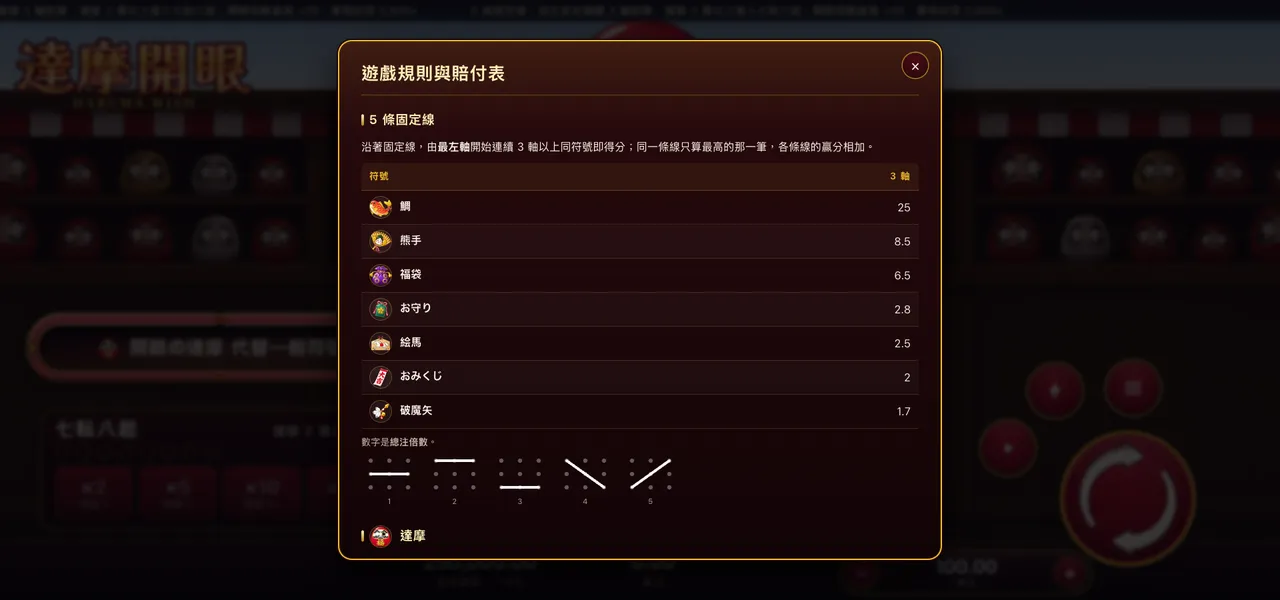
Daruma Wish — In-game paytable
In-game paytableThe same game definition as the table on this page: the game receives it from the server, and this page reads it at build time.

Specification

Type3 × 3 reels, 5 fixed lines (3 of a kind from the left)
Return to player (RTP)96.82%
VolatilityMedium (4.89)
Hit rate25.17%
Rounds winning ≥ 1× bet25.17%
Max win per round2,500× bet
Nanakorobi Yaoki (sticky respins) frequency≈ 1 in 45.49 spins
RTP verificationExact solution: base game and feature computed exactly (not sampled), zero error; RTP 96.8203%

Game math specifications and the paytable are read at build time from the definitions shared with the server code. See Math version for the configuration shown; confirm any other version or operator-specific settings separately.

How wins work

  • The grid is 3 reels × 3 rows with 5 fixed lines (three across, two diagonals). 3 of the same symbol on a line wins.
  • The Daruma and the Open-eyed Daruma are both Wild and substitute for every regular symbol; a line made entirely of darumas pays as the highest-paying symbol.
  • When several lines win on the same spin, each is calculated separately and added.
  • Landing 2 or more darumas triggers sticky respins (up to 8) where brushes paint the second eye to raise the multiplier (up to ×10); if no line has formed when respins end, the daruma stands up and spins again when a line forms or for up to 100 additional spins.

Paytable

Values are the symbol multiplier in: line win = (bet ÷ 1000) × symbol multiplier. A line made entirely of darumas pays as the highest-paying symbol (the sea bream). During the respins only the final board pays, multiplied by the eye multiplier.

Symbol3 reels
Tai, the lucky sea breamHigh-pay 25
Kumade, the lucky rakeHigh-pay 8.5
Fukubukuro, the lucky bagHigh-pay 6.5
Omamori, the charmLow-pay 2.8
Ema, the votive plaqueLow-pay 2.5
Omikuji, the fortune slipLow-pay 2
Hamaya, the lucky arrowLow-pay 1.7

Special symbols

Daruma

Wild, substitutes for every regular symbol. 2 or more trigger the respins, and every daruma sticks during them. Once a brush paints its second eye it becomes an Open-eyed Daruma (still Wild); the number of open eyes sets the final multiplier.

Brush

Appears only during the respins and pays nothing itself. When it lands it paints the second eye on every daruma directly next to it.

Features

Nanakorobi Yaoki — sticky respins

2 or more darumas on a spin trigger the feature: every daruma sticks and the other cells respin. Each new daruma that lands earns another respin, up to 8; a board full of darumas also ends it. The triggering spin pays as usual. It triggers about once every 45.49 spins.

Opening the eye

A brush landing during the respins paints the second eye on every daruma directly above, below, left or right of it (including darumas that landed on the same spin), turning it into an Open-eyed Daruma. When the feature ends, the final board's line wins are multiplied by the eye multiplier: 1 open ×2, 2 open ×5, 3 or more ×10.

Yaoki — stand back up and spin again

If no line has formed when the respins end, the daruma stands back up and spins again. This ends when a line forms or after 100 additional spins. If the limit is reached without a line, this stage ends without a win. The intermediate respins pay nothing; only the final board pays.

Mangan Joju — the wish fulfilled

Nine open-eyed darumas: all 5 lines pay as the top symbol, the sea bream, then Mangan Joju ×20 (in place of the eye multiplier, not on top of ×10) — that board is the game's cap of 2,500×. It is a cap you can actually reach: both the production engine and an independent simulation have hit it.

Medium volatility — one feature, done well

Volatility 4.89. Hit rate 25.17% counts rounds with any win; 25.17% of all rounds return at least the stake (the lowest line already pays more than the bet). No free spins, no bonus buy — one signature feature you can read at a glance, including how many eyes you are from ×10.

Technical

Game codeaki_daruma
Math versiond1
TechnologyHTML5, no plug-in; one client for desktop and mobile
ViewportLandscape with proportional scaling
In-game languageTraditional Chinese (additional languages on request)
CurrenciesTWD (others can be registered on request)
IntegrationTransfer wallet (Operator API v3), launch-token redirect

Sources & verification scope

This product specification is written and maintained by its developer, Akitsora Gaming (AKI電子 in Taiwan). Measurement methods and sample information for RTP, volatility and hit rate appear in the specification table. Sampled results have uncertainty; RTP describes long-run return, not an individual player or session outcome.

Internal simulations and tests are not independent certification. We do not currently hold GLI or BMM certification reports. Supply to a market requiring third-party certification depends on completing its requirements.

See slot game development and supply for integration and supply scope, About us for development and content responsibility, or contact us for a math summary, version confirmation or a correction to this page.

The story

Fiction and adapted settings written by Akitsora Gaming for this title, including invented dialogue and events. This is not a historical or folklore reference. The rules and specification tables define the gameplay and math.

Fall seven times and rise eight—a single brush-stroke awakens the solemn vow.
Every tumbling doll rights itself in red and gold until the temple bell rings out.

I. One Eye Painted First

When a crimson papier-mâché daruma is first brought home from a winter temple fair, both of its round eyes are left blank white. Whoever makes a wish dips a brush in black ink and paints in a single pupil—just like the giant Daruma presiding above the reels, watching quietly over every spin with one eye open and one eye waiting.

The second eye is reserved for the day the wish is finally fulfilled in full. Across this compact three-by-three grid, opening that second eye is never mere ornament on the wooden cabinet; only when an ink brush lands beside a daruma during the feature and turns it into an Open-eyed Daruma does the round’s true multiplier awaken. With every tumble across the woven tatami floor, the weighted papier-mache figure embodies unyielding patience and quiet resolve.

II. The Tumbler That Rises Again

Weighted heavily at its rounded base, a traditional daruma doll rocks right back upright no matter how many times it is tipped over on the tatami mat. From that simple, stubborn resilience comes the famous Japanese proverb Nanakorobi Yaoki—falling down seven times is never defeat so long as you rise an eighth time to face the spinning board. Incense smoke coils around the cedar rafters of the temple workshop while rows of scarlet dolls gleam softly in the morning light.

Landing enough Daruma Wilds on a single spin triggers the sticky respin feature: every daruma locks in place while the remaining cells spin again, and each new daruma that drops in extends the run. Meanwhile, any Brush that lands paints the second eye on every adjacent daruma above, below, left, or right to climb the multiplier tiers. With every tumble across the woven tatami floor, the weighted papier-mache figure embodies unyielding patience and quiet resolve.

III. Standing Up for One More Try

Sometimes the sticky respins come to an end with darumas scattered across the board alongside beckoning cats, gold koban coins, pine-bamboo-plum emblems, and festive sea bream, yet without a single completed payline. True to its name, the giant daruma above the reels is knocked over and rocks right back onto its feet to begin Yaoki. Incense smoke coils around the cedar rafters of the temple workshop while rows of scarlet dolls gleam softly in the morning light.

During this refusal to stay down on the mat, the unlocked cells keep spinning again and again until a winning line forms across the grid or the extra stand-up spins reach their limit. Because intermediate respins do not pay on their own, every locked doll and painted eye builds toward the final settled board at the end. With every tumble across the woven tatami floor, the weighted papier-mache figure embodies unyielding patience and quiet resolve.

IV. Sunset at the Daruma Market

Every winter across Japan, temple courtyards and shrine approaches fill with rows of scarlet stalls for the annual Daruma Market. Beneath red-and-white striped curtains and dark wooden counters, visitors return last year’s two-eyed dolls in gratitude and choose a fresh, blank-eyed tumbler to carry home for the new year ahead. Incense smoke coils around the cedar rafters of the temple workshop while rows of scarlet dolls gleam softly in the morning light.

Whenever the sticky respins begin, the sky behind the wooden stall shifts into the warm amber glow of sunset, capturing the temple market at its liveliest evening hour. Should all nine cells on the board fill with gleaming Open-eyed Darumas, the round achieves Mangan Joju—a grand wish fulfilled in full across every line. With every tumble across the woven tatami floor, the weighted papier-mache figure embodies unyielding patience and quiet resolve.

Want to spin Daruma Wish yourself?

The demo needs no account — click and spin. For integration docs, the math summary or sandbox access, send us an email.

Demo play uses virtual credits with no monetary value.