




The story
Fiction and adapted settings written by Akitsora Gaming for this title, including invented dialogue and events. This is not a historical or folklore reference. The rules and specification tables define the gameplay and math.
The fifteenth day of the ninth month, Keicho five. Dawn at Sekigahara. Inside the fog there are no banner colours and no sides — the realm belongs to nobody yet.
I. Fog
Sekigahara is not a plain. It is a basin where four roads meet inside the mountains: one running east toward Edo, one west toward Kyoto, and two more tying the northern provinces to Ise. Whoever holds this ground holds every road home — and both sides knew it, which is why that autumn two armies of tens of thousands each spent an entire night marching through rain in order to halt on the same slope.
By dawn the basin had filled chest-deep with fog. The scouts put the enemy three hundred paces off, and from the curtain of the headquarters you could see nothing at all: only horses blowing, only a man somewhere out in the white retying the cord of his helmet, only your own heart running faster than it had the day before.
The quietest moment of that morning was the one after everyone had taken their place and before anyone had given an order. That is the moment this game is built around.
II. The baton and the naginata
A commander's baton stands at the centre of the headquarters. The man holding it has no name here — or rather, his name has been copied, adapted and printed onto so many things across four centuries that it stopped being his some time ago. So this general flies no house banner and the back of his surcoat is bare. He is simply the one who has to decide everything before the fog lifts. His helmet is tucked under his left arm rather than worn, because the fog is heavy and a helmet would cost him the sounds coming up the slope.
A woman stands at his right. People like her usually get half a line in the chronicles: women too took up the naginata and stood in the ranks. She wears a hachigane brow-plate rather than a helmet, and her scarlet hakama is the only colour on the whole grey slope. The naginata is held across her body, edge outward — a posture of waiting, not of attack.
There is nothing supernatural anywhere in this one — no god, no spell, no dragon. Sekigahara actually happened: the strength of both armies, the rain that fell that night and the four roads out of the basin are all on record. Everything that can happen on this board was done by somebody that morning. It is about people, and a story about people needs somebody standing at the edge of it, watching. That is why those two frame the board, and not any god.
III. Four helmets
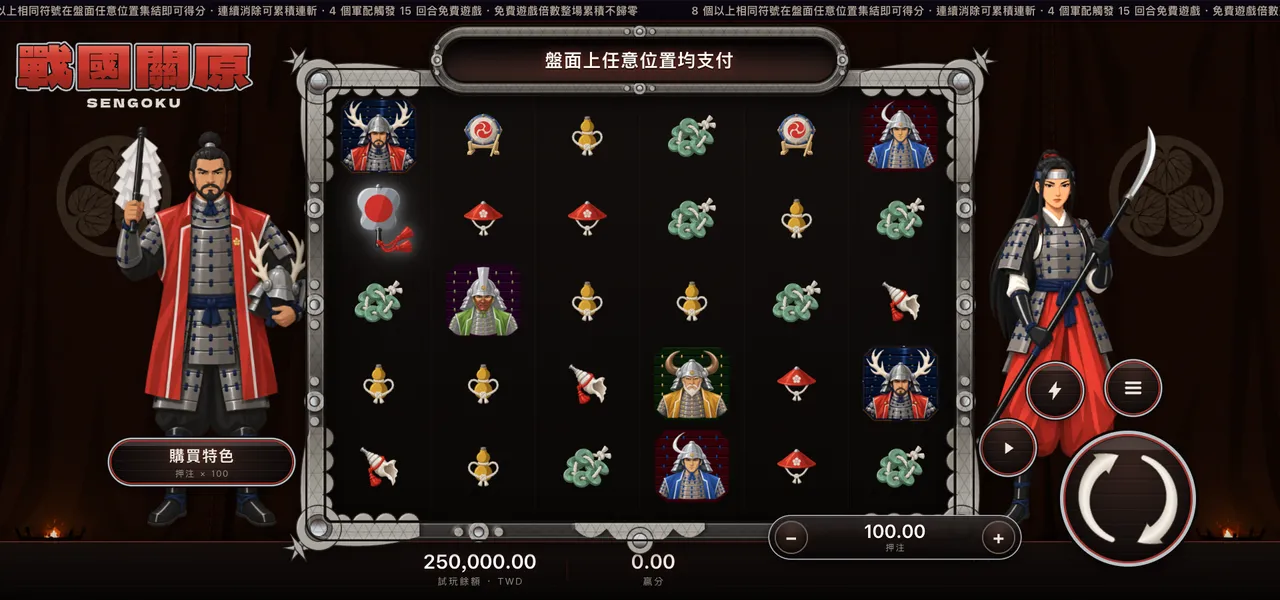
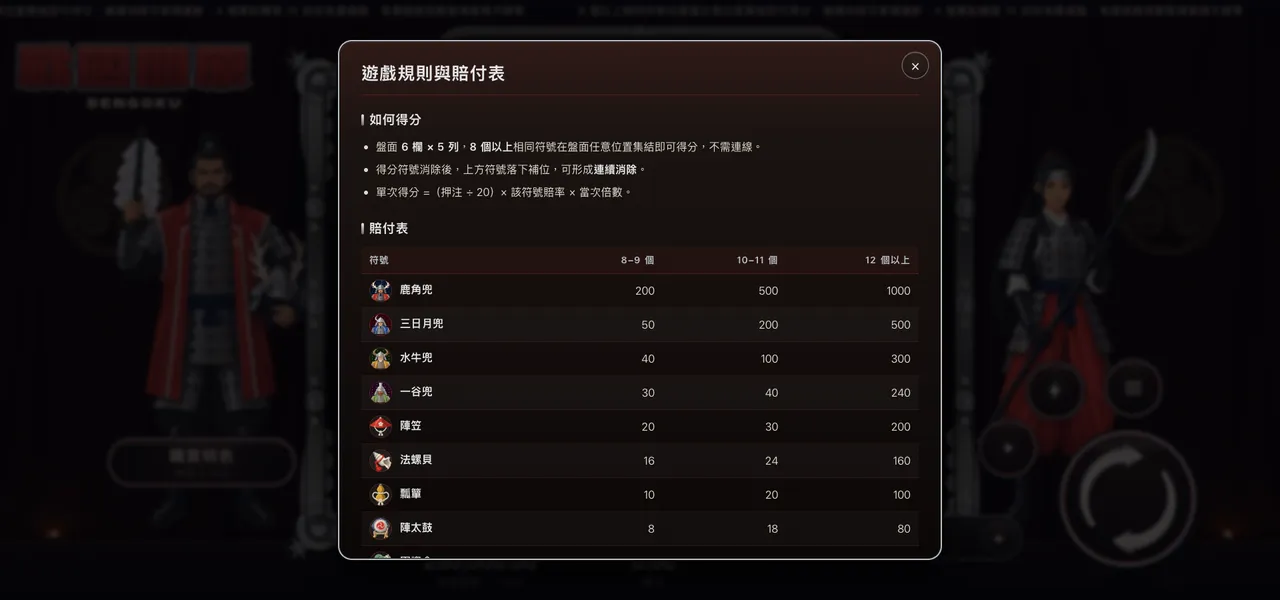
The four highest-paying symbols are four helmets.
Deer antlers, a crescent moon, buffalo horns, the swept crest of Ichi-no-tani — all four are real maedate forms, and none of them points at any particular person. A crest was never decoration. In a melee where dust and shouting swallow everything, it is how a foot soldier finds whether the head of his own unit is still standing. So it had to be legible at a distance, and it had to look like nobody else's.
The lamellar plates of helmet and cuirass are laced together with coloured silk cord: odoshige. Dark blue, scarlet, spring green, purple — the colour is not taste, it is rank. Which house laced with which silk had been settled generations earlier, so the first thing a man was seen as on that field was something his grandfather decided for him.
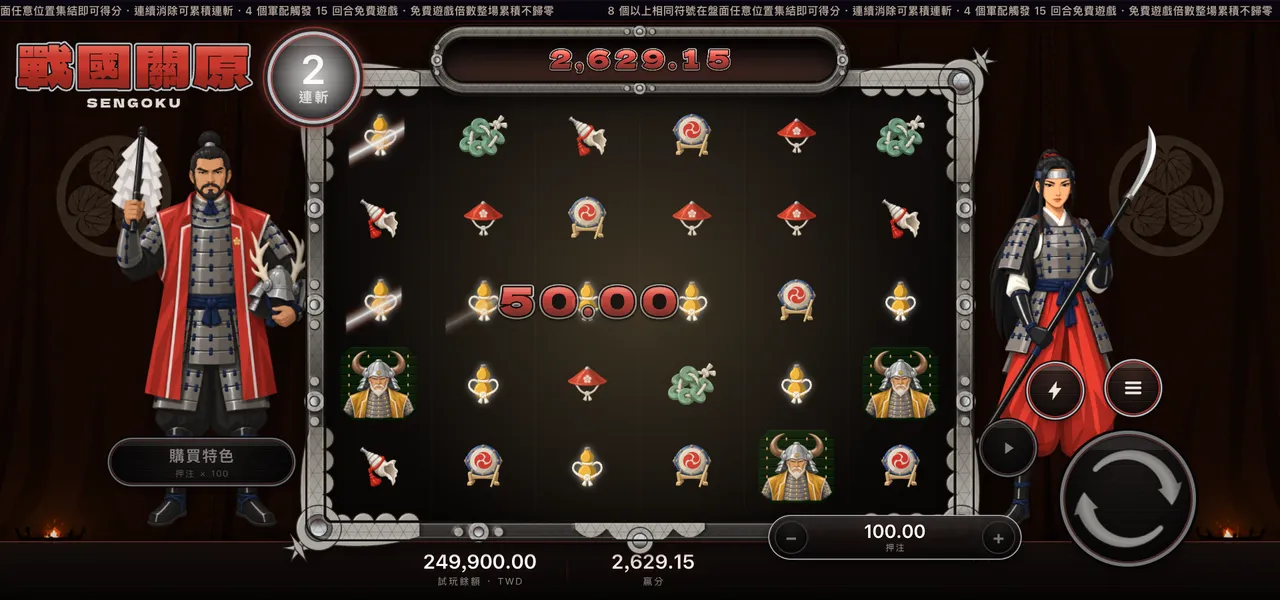
The four helmets on the board, then, are four different companies deploying across the same slope at the same time. 8 or more of the same helmet anywhere on the board pay, with no line and no adjacency required — on ground like that, formations never did fall into a straight line.
IV. What the foot soldiers carried
The remaining five symbols are the same battle seen from the bottom.
The jingasa is lacquered vermilion: a sunhat, a cooking pot, and the last thing you get in front of your face. The conch hangs at the hip — one long note to advance, three short to fall back; past the distance a shouting man can reach, the conch is the only language there is. The gourd carries water, and half a day into a fight water matters more than rice. The war drum is carried by two men, and the beat decides which foot everyone puts down next; when the drum stops, the line comes apart.
The fifth is the war chest: pierced coins strung loosely on hemp cord, deliberately not arranged into any family's crest. The Sengoku period was not settled by swords in the end, it was settled by money — whoever could keep paying his foot soldiers by the day kept his line standing one day longer.
These five are the real protagonists. The four helmets get written into the books; these do not, and yet they appear on the board far more often — much as the overwhelming majority of the people actually standing in that fog were never written down at all.
V. The war fan goes up
Besides the baton, the general carries a gunbai.
The gunbai is not a weapon. It is a fan cast in iron with a sun disc struck into its face, and it does exactly one thing: the instant it goes up, the whole army sees it. When the banners have been eaten by fog and the orders have been blown apart by wind, the flash off that iron fan is the only signal the entire line still shares.
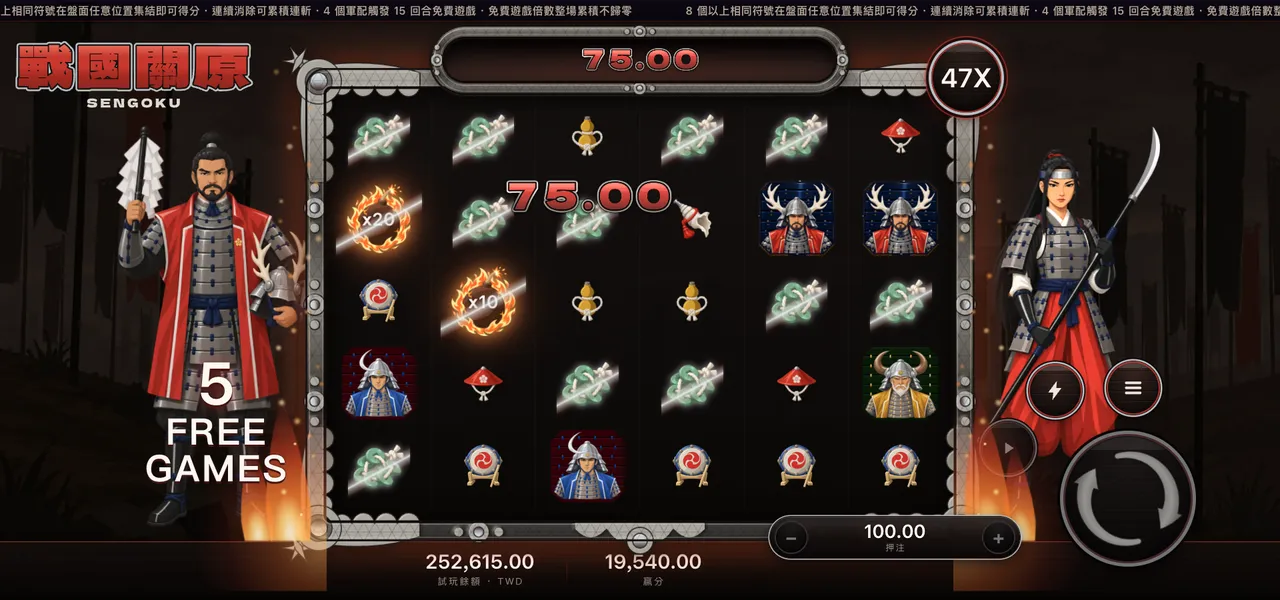
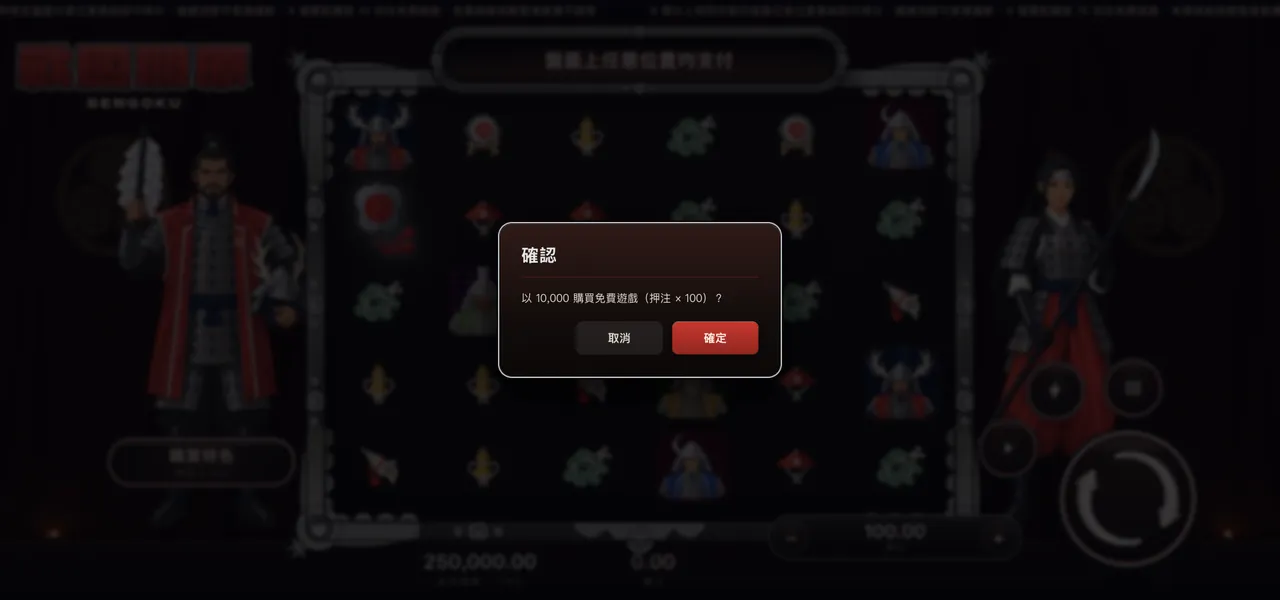
So in this game the war fan counts wherever it lands — a signal does not need to line up. 4 of them lit at once means the army has moved: for the next 15 rounds the fog pulls back off the slope and the forest of banners drives all the way down to the foot of the mountain. Raise 3 more mid-pursuit and the line runs on for another 5 rounds.
VI. The firebomb
A horokudama is made of fired clay: powder inside, cord wrapped outside, lit and then thrown by hand — and anyone who has held one knows exactly how little room that leaves for second thoughts.
It is this game's multiplier orb. It counts when it is on the board as a win lands — ×2 to ×20 — and nobody has to go and pick it up. That is how it worked in the field as well: once thrown it belongs to no one, and all anyone can do is wait for it to come down. In free spins it is heavier still, ×2 to ×500, and every one thrown stays on the ledger, stacking, never resetting for the whole feature — because once a rout begins it does not stop halfway, which is precisely what happened on that slope that afternoon.
VII. The fog lifts
By early afternoon it was decided, and the smoke had cleared.
Seen from the ridge, the thing had taken half a day. Yet for four centuries afterwards everyone has argued about one particular instant inside that half day: why a certain company never moved, why a certain banner went down so fast, whether a quarter of an hour more fog would have produced a different country. The direction of an entire era was compressed into the length of a few breaths.
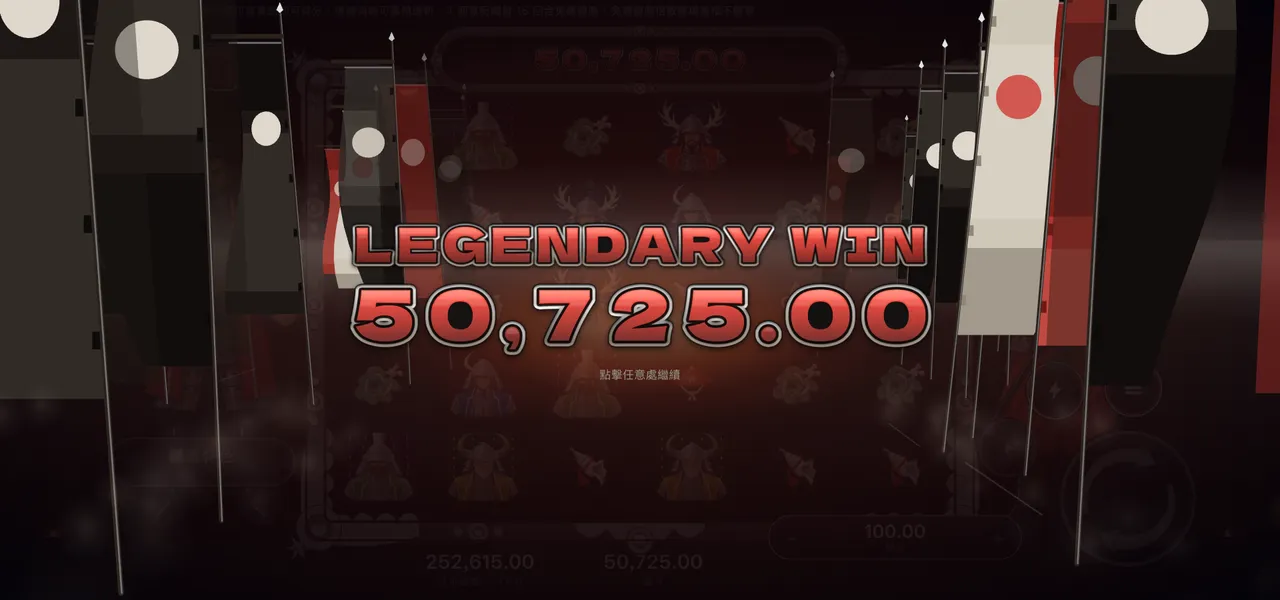
This game keeps that instant as a board. A single round is capped at 5,000× the bet — less a number than the largest way this game knows how to write the phrase the realm divided.
The rest of the time you stand in the fog and wait for the fan to go up.