






The story
Fiction and adapted settings written by Akitsora Gaming for this title, including invented dialogue and events. This is not a historical or folklore reference. The rules and specification tables define the gameplay and math.
This garden has no season.
I. A garden without a season
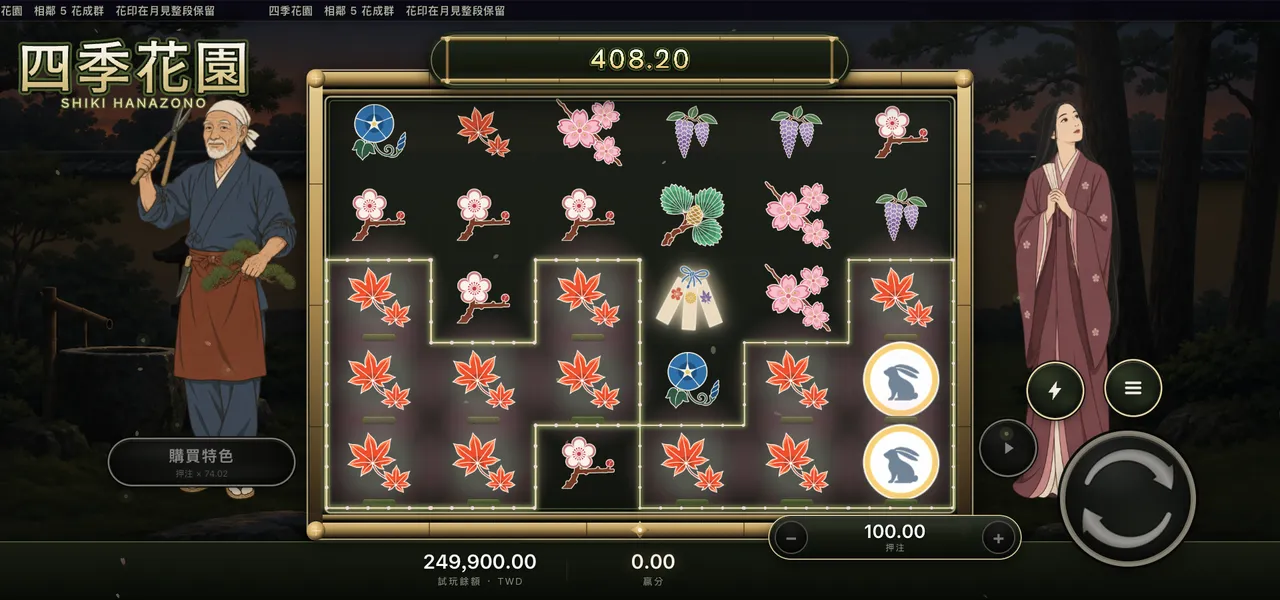
West of Kyoto there is a garden that is not open to the public. It is small, ringed by a four-eye bamboo fence, and floored wall to wall with moss. Look in from the gate and something reads wrong — it takes a few seconds to place it: cherry and maple are open on the same tree, chrysanthemum and morning glory share one bed of moss.
The gardener says this is not his doing. The garden was already like this when he came; he sweeps it, prunes it, and lights the stone lantern. Forty years, and he has never seen it go over.
II. The mark
There are marks in the moss.
Not carved — grown. One patch is a shade deeper and brighter than the moss around it, in a shape like a small seal. The gardener calls it a flower mark: a flower opened on this ground, and the moss remembered.
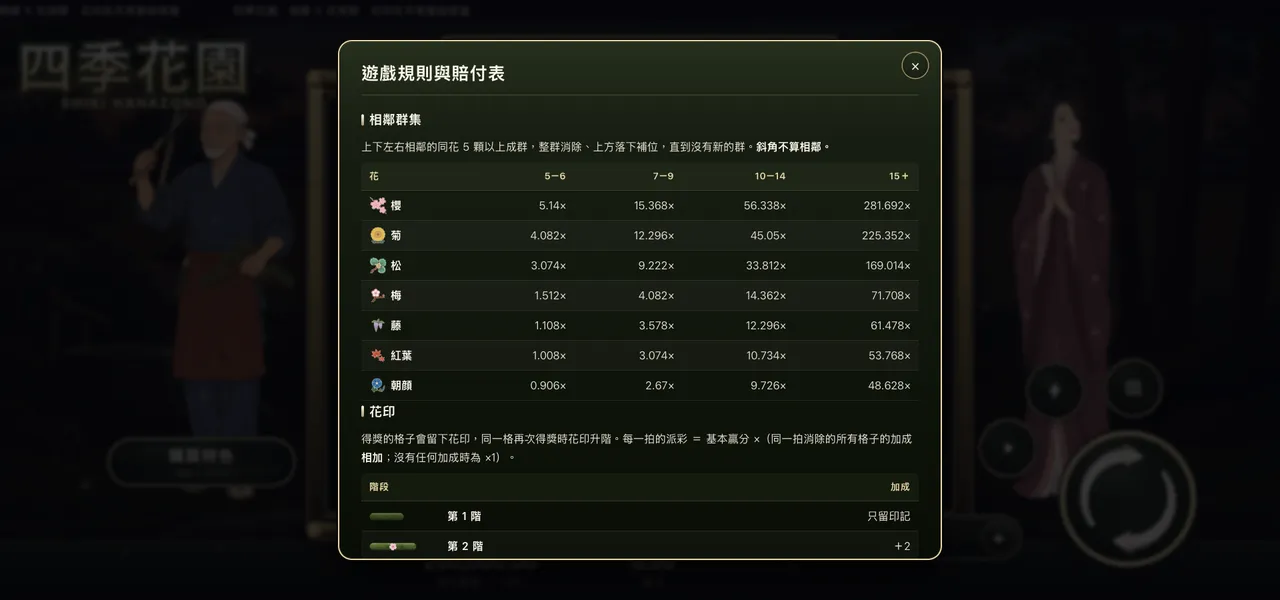
Ground that remembers opens more easily. The second flowering deepens the mark; the third and the fourth deepen it again, up to full bloom. And a deeper mark makes what grows there worth more — when several marked patches are taken together, their bonuses are added, not multiplied. The gardener puts it plainly: people can only keep count of what adds up.
The first flowering only leaves the mark; it deepens nothing. The first time, he says, the ground notices you. It does not remember you yet.
III. Adjacent
The garden has one rule: they must touch.
5 or more of the same flower joined up, down, left or right make one bed. Corner to corner does not count — the gardener calls that two plants, not one bed. A bed is cut all at once, what is above falls to fill the gap, and it goes on until nothing joins any more.
How much a bed is worth depends on how many flowers it holds, not on which corner of the garden it grew in — except for what the moss has remembered there.
IV. The moon and the paper strips
East of the fence there is a well, and the well holds the full moon.
The moon is not a flower, but wherever it falls it counts with the flowers beside it, and two beds that were separate become one. It cannot flower by itself, though: every bed needs at least one real flower. Moon reflecting moon is not something the gardener would even walk over to sweep.
Tanzaku hang on the fence — narrow paper strips tied to the bamboo, turning over in the wind. They join no bed. They do one thing: they count. On the night 4 of them are hanging, the gardener lights every lantern in the garden.
V. Tsukimi
That night is called Tsukimi, moon-viewing, and it runs 15 rounds.
On ordinary days the marks fade by morning — the gardener sweeps once at dawn and yesterday's marks are gone. On the night of Tsukimi he does not sweep. The marks stack, the same patches flower again and again, and by the small hours a few of them are deep enough to give off their own light. Measured over a full session, the deepest patch averages stage 3.88.
If the wind turns 3 more tanzaku during the night, the night grows by 5 rounds, and not one mark goes back.
VI. The gardener and the lady
Two people stand in the garden.
The gardener is on the left: work clothes, a towel round his head, shears in one hand and a pine branch in the other. He does not look at the moon. He looks at the ground — for forty years he has been checking the same thing, which patch of moss learned something today.
The lady is on the right, in layered court robes, a closed fan at her chest, looking up at the moon. She does not work. She watches. The gardener said it once: perhaps this garden has no season because somebody here has been waiting a long time, and for someone who waits it is always the same time of year.
Towards dawn the lanterns go out one by one and the marks fade. The gardener picks up the bamboo broom and starts from the well on the east side.