







The story
Fiction and adapted settings written by Akitsora Gaming for this title, including invented dialogue and events. This is not a historical or folklore reference. The rules and specification tables define the gameplay and math.
“There are three places in Edo where a thousand ryo falls in a single day: the fish market at dawn, the theatre district by day, and Yoshiwara at night.”
— An Edo saying
I. The shop curtain goes up
A little after six, the heavy shutters come down one panel at a time. The apprentice carries out a pail and throws water across the paving stones before he sweeps. Then the head clerk hangs the noren, the split curtain, over the doorway — and with that the day's trade begins. Take the curtain down and nobody walks in again. This shop's day is measured by the height of a piece of cloth.
This is Nihonbashi. At one end of the bridge is the fish market; at the other, the wholesalers and their rows of white-walled storehouses. The trade on this street is the trade of handling things: rice, cloth, tea, vessels — and money itself. The morning sun has just cleared the eaves, and the abacus on the counter is in plain view. This game happens in daylight because daylight is when business is done.
II. The four who work here
The banto, the head clerk, is the top of this shop in everything practical. He sits behind the counter in his spectacles and works the abacus so fast that the people beside him hear only the beads knocking together and cannot tell which column he is on. The detchi, the apprentice, came into service at around ten years old — sweeping, running errands, copying entries. First he becomes a tedai, then a banto. Twenty years lie in between.
The tea girl brings the tea out. In Edo a negotiation begins with a bowl of it, and the price is usually still unsettled when the bowl is empty. The hikyaku, the courier, ties his straw sandals tight in the doorway: letters between Edo and Osaka are carried by relay, leg after leg, and the fastest service arrives in three days. Every bill of exchange, every overdue account, every urgent word this shop sends is riding on those legs.
These four work for the shop. They do not own it.
III. What sits on the counter
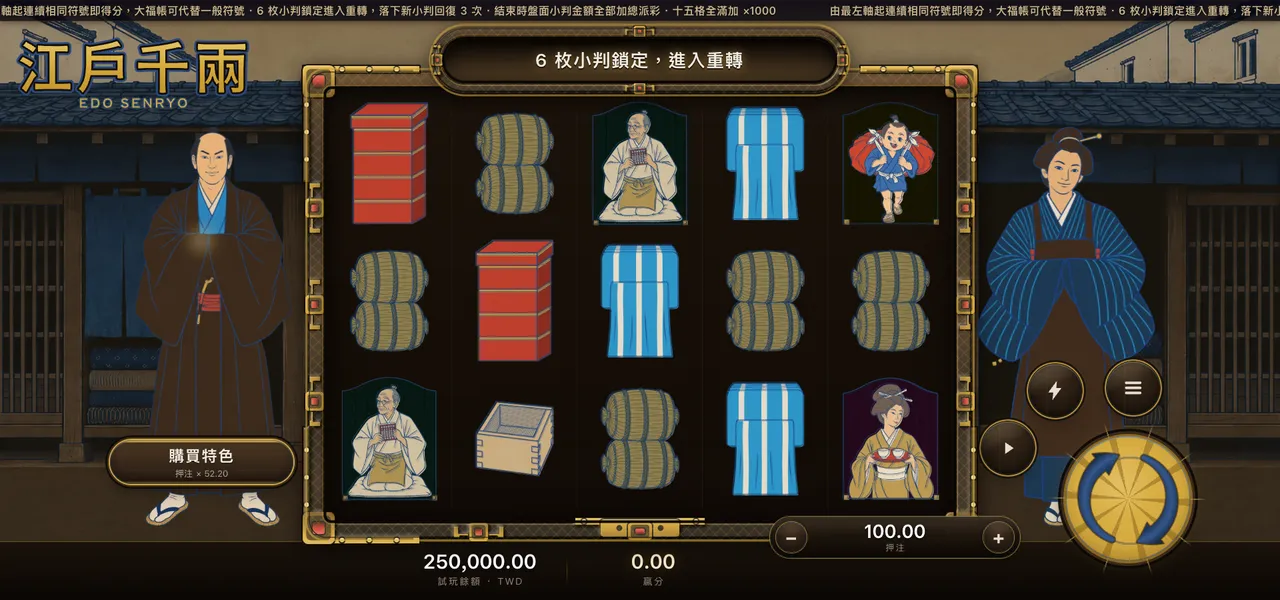
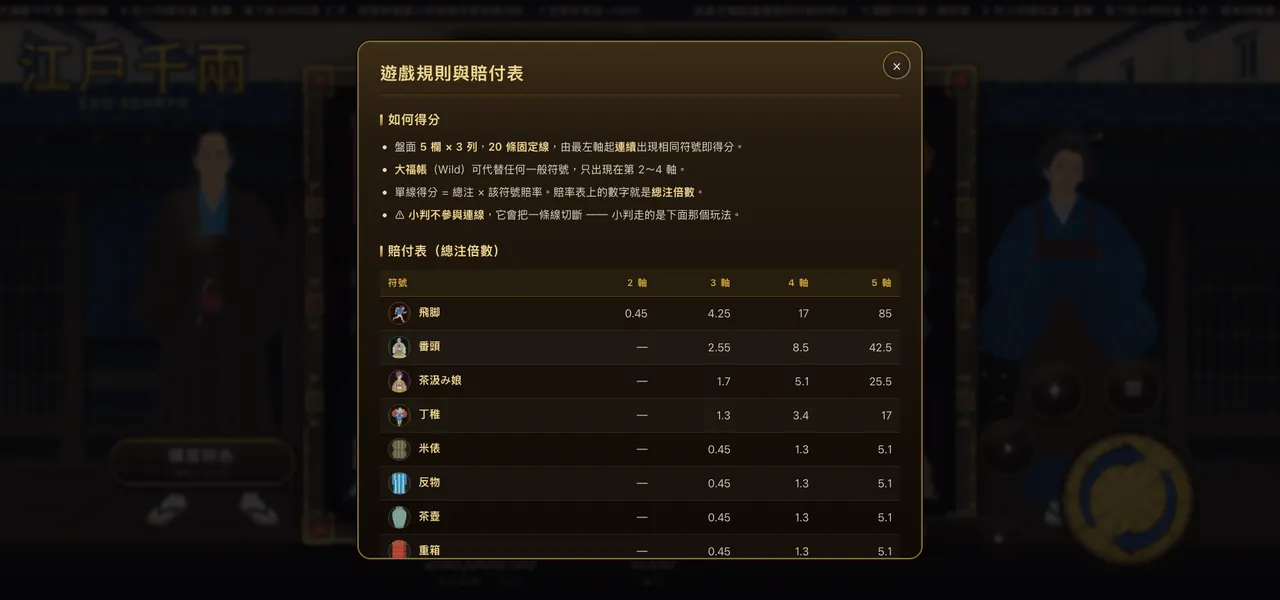
Rice bales, bolts of cloth, tea jars, stacked lunch boxes, and a masu — the five goods on the reels are what the shop handles. The plainest of them is the masu, the wooden measuring box for rice, beans and sake. Edo commerce begins with measuring, and one wrong masu puts the whole street's prices out.
And there is the daifukucho, the great ledger: the merchant house's master account book, brushed on mulberry paper and bound by hand, a single volume covering decades. Edo burned often, and when it did, the first thing carried out of a shop was not the cash box but this book. With the ledger, every debt in both directions still exists. Without it, the house is finished whether or not it burned.
The ledger's talent is that anything can be written into it — a line of rice, a line of cloth, a line for what a certain family still owes from last month. That is why the ledger on the reels can stand in for any of the goods and complete a piece of business that was left half-done.
IV. The koban
A koban is not goods. It is the price of everything else on the street — and this game puts that price on its face: every koban that lands carries a tag at its lower rim with exactly what it is worth.
Which is also why a koban does not queue up with the rest. Goods can be laid out one after another and added up into a single sale; money cannot. Put one koban into that row of goods and the line of business stops there. That is not a rule written badly — it is the rule of the house: money is not for sale.
A koban bounces once when it lands, then settles. In the instant it settles, everyone in the shop looks up.
V. After the shutters close
Dusk. The curtain comes in, the shutters go back up panel by panel. Only once the street has gone quiet does the shop begin the real work of the day: counting. A paper lantern goes into the storehouse; the threshold is high and has to be stepped over.
Land 6 koban or more in a single spin and they lock exactly where they fell — nobody is allowed to move them again. That is the money changer's rule: once coin is set down it is not shifted, because nobody trusts a total counted from money that was moved. The rest of the board keeps spinning, and the storehouse keeps giving things up.
The chōgin, the money changer's silver, arrives partway through. Its job is conversion: reducing every gold and silver piece on the scales to one figure. So at the moment it lands, the values of every koban on the board are added up and copied onto it — while the original koban stay where they are and still count at the end.
The lucky pouch belongs to the theatre — on a full-house day the playhouse hands one to everyone who worked it. Its meaning in the storehouse is just as simple: the house was full tonight, so double the lot.
The treasure chest was already stacked at the back of the storehouse. It was not earned this evening; it was put away one chest at a time over the years — which is why it carries a fixed sum that has nothing to do with today's trade.
The storehouse allows 3 spins, and every new koban that falls sets those 3 back to the beginning. The ledger does not close until the count is done.
VI. Senryo — a thousand ryo
The night all 5 × 3 cells turn to koban is the one that earns the name: senryo, a thousand ryo — and on top of the storehouse's count comes a further 1000× the stake. The name is the rule: a thousand-ryo chest holds a thousand ryo.
Edo people said there were three places in the city where a thousand ryo fell in a day: the fish market at dawn, the theatre district by day, Yoshiwara at night. Those are three places packed shoulder to shoulder — a thousand ryo built up out of thousands of people, one copper at a time.
This shop is not on that list. Its thousand ryo takes a whole storehouse, a whole year of accounts, and a whole relay of legs running to Osaka. So it is rare, and it is meant to be rare: if it happened often, it would not be a thousand ryo.
VII. The two who watch
The danna, master of the house, stands on the left in a long haori, arms folded, his pipe tucked through his sash and never lifted. The okami, mistress of the house, stands on the right in a striped kimono and a plain apron, a single pin through her marumage, both hands folded in front of her.
Neither of them is working. The shop is run by the other four; what the owners do is watch — goods coming in, entries going down, and which cell a koban settles in. Every large house in Edo was like this: the master does not handle it. The master knows it.
Tomorrow morning the shutters come down again, water goes across the stones again, and the curtain is hung back up. That is how a day on Nihonbashi starts.