AKITSORA GAMING

Kabuki Mie

Strike the pose — every mask on stage counts at once.

Kabuki Mie is a 6×5 pay-anywhere cascading slot. Kumadori masks (×2–×500) fall with the symbols; at the end of a spin they add up and multiply the win.

Demo play uses virtual credits with no monetary value.

RTP
96.47%
Volatility
High13.42
Max win
20,000× bet
Bonus buy
103.80 / 160.59× bet

In-game screens

Captured straight from the running game — real boards, real wins.

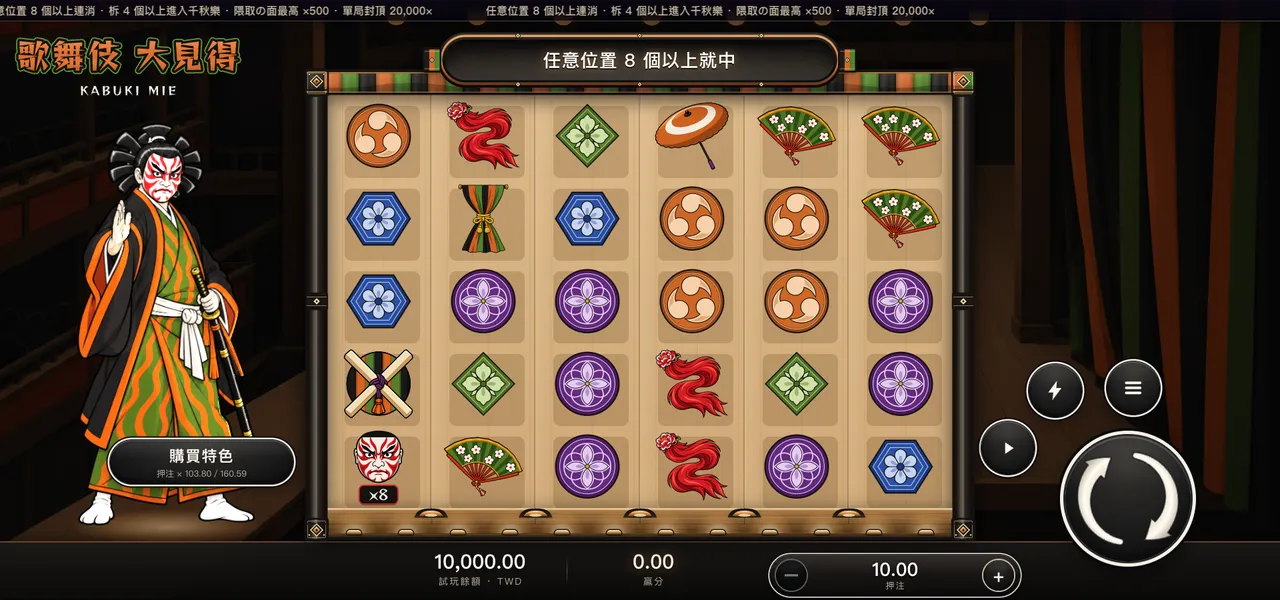
Kabuki Mie — Base game
Base game6 reels × 5 rows, pay anywhere with 8+ symbols. The actor stands on the hanamichi to the left; the faces on the grid carrying multipliers are kumadori masks.
Kabuki Mie — A cascade win
A cascade winDance fans and hanabishi crests each reach 8+ on the grid, light up and clear; the grid refills and pays again.
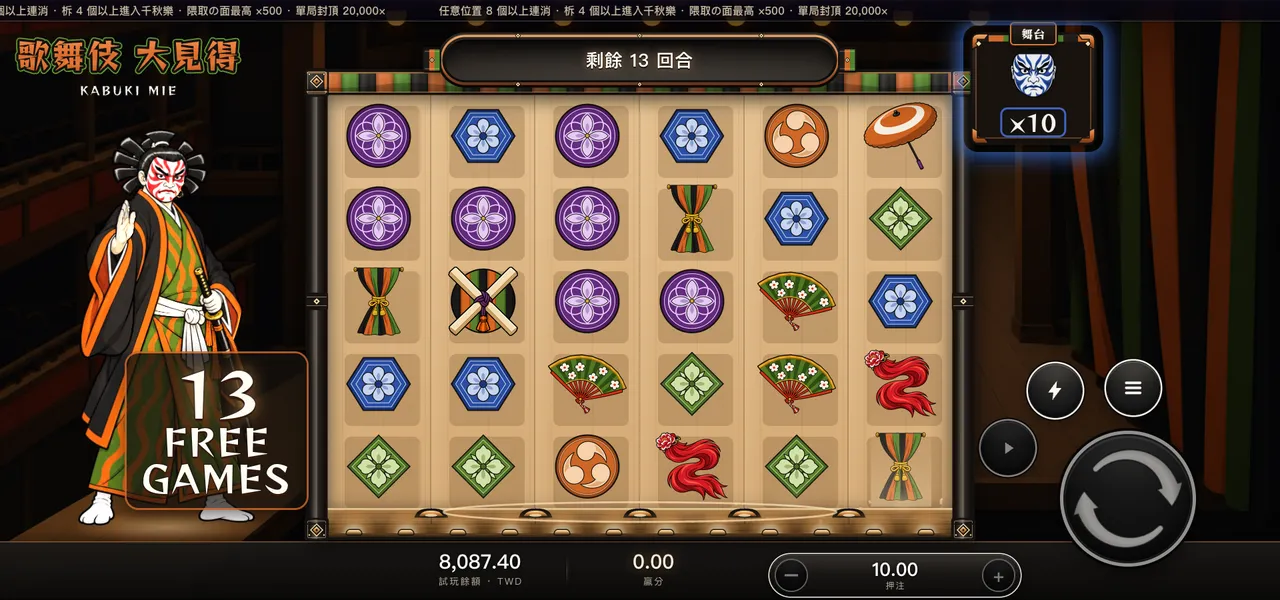
Kabuki Mie — Closing Night — locked on stage
Closing Night — locked on stageA gold mask merged by a mie is locked on stage (top right) and two red masks have just landed; the actor has already made his quick change into the blue-and-white costume.
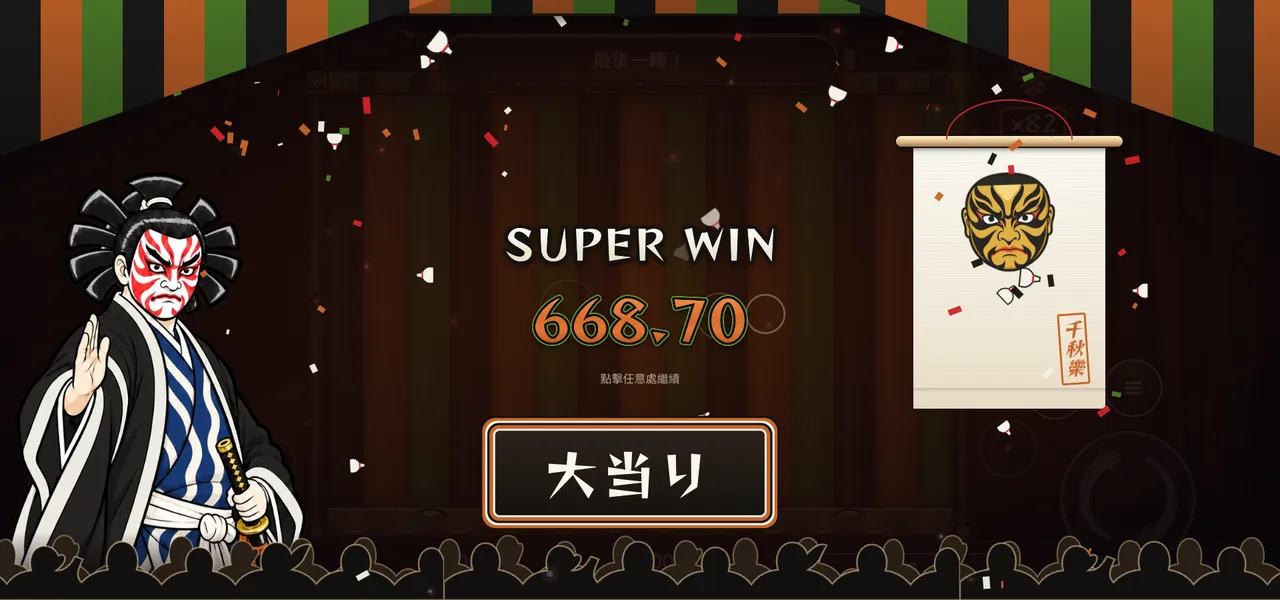
Kabuki Mie — Big win
Big winCapped at 20,000× the bet per round.
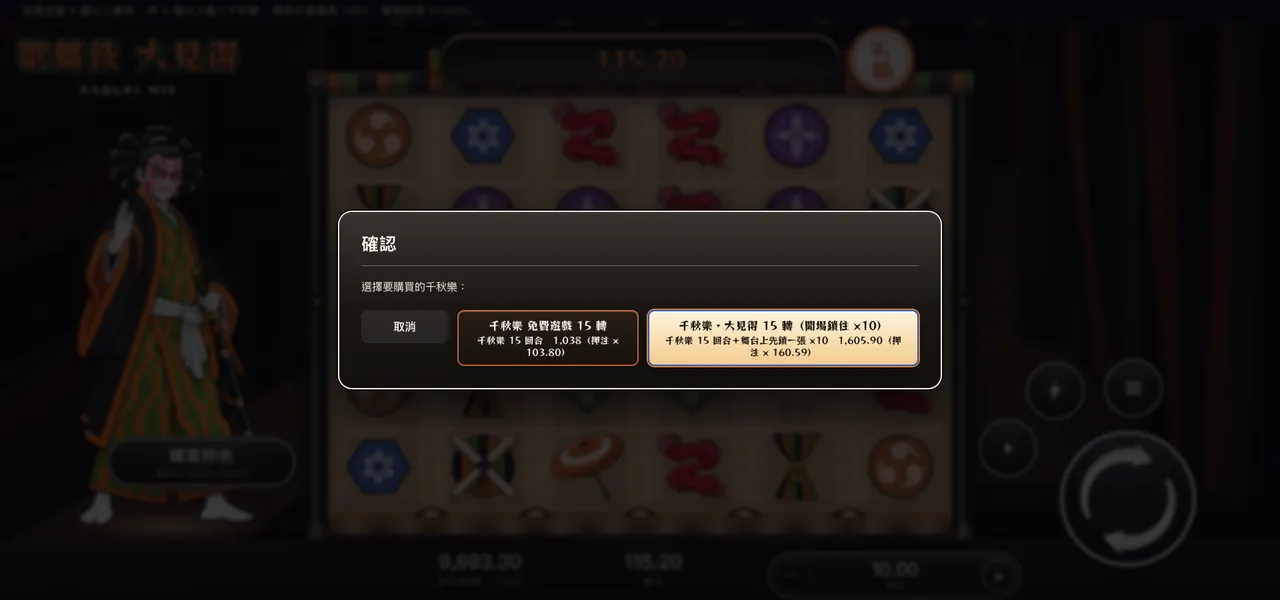
Kabuki Mie — Bonus buy
Bonus buyTwo tiers: 103.80× for Closing Night, 160.59× for Closing Night · Mie (opens with ×10 locked).
Kabuki Mie — In-game paytable
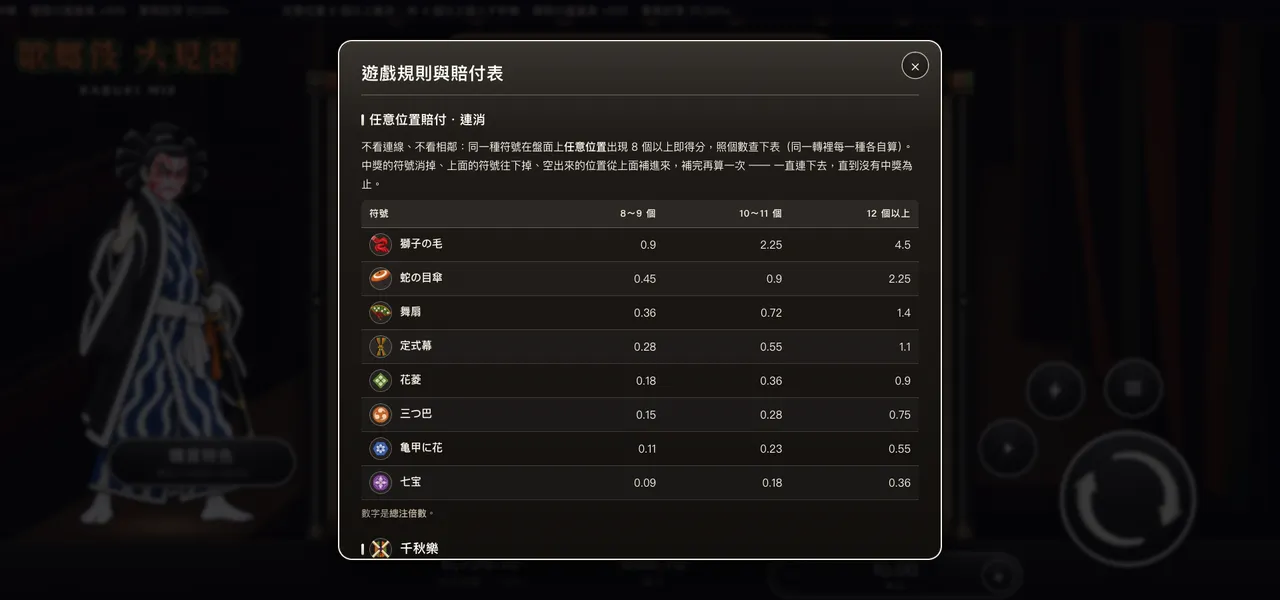
In-game paytableThe same game definition as the table on this page: the game receives it from the server, and this page reads it at build time.

Specification

Type6 reels × 5 rows, pay anywhere with cascades (8+ of the same symbol anywhere on the grid; no lines, no adjacency)
Return to player (RTP)96.47%
Bonus buy RTP (Closing Night)96.47%
Bonus buy RTP (Closing Night · Mie)96.47%
VolatilityHigh (13.42)
Hit rate46.51%
Rounds winning ≥ 1× bet10.68%
Max win per round20,000× bet
Closing Night (free spins) frequency≈ 1 in 200.93 spins
Calibration sample4,960,000,000 spins, standard error 0.02%

Game math specifications and the paytable are read at build time from the definitions shared with the server code. See Math version for the configuration shown; confirm any other version or operator-specific settings separately.

How wins work

  • The grid is 6 reels × 5 rows. There are no paylines and symbols do not need to touch.
  • A symbol pays when 8 or more of it appear anywhere on the grid; the table is read by count (8–9 / 10–11 / 12+), and every symbol in a cascade pays on its own.
  • Winning symbols clear, the symbols above fall, new symbols drop in from the top and the grid pays again — until nothing wins.
  • When the cascades stop, the multipliers on every kumadori mask on the grid are added up and multiply the spin's total win; a spin with no win is not multiplied.

Paytable

Values are multiples of the total bet: a symbol pays by how many of it are on the grid, win = total bet × table value (the same numbers as the in-game paytable). Once the cascades stop, the spin's total win is multiplied by the sum of the kumadori masks on the grid (plus the mask locked on stage during Closing Night).

Symbol8–910–1112+
Lion's mane (shishi wig)High-pay 0.92.254.5
Janome umbrellaHigh-pay 0.450.92.25
Dance fanHigh-pay 0.360.721.4
Jōshiki-maku curtainHigh-pay 0.280.551.1
Hanabishi crestLow-pay 0.180.360.9
Mitsudomoe crestLow-pay 0.150.280.75
Tortoise-shell flower crestLow-pay 0.110.230.55
Shippō crestLow-pay 0.090.180.36

Special symbols

Kumadori mask

Multiplier symbol (×2–×500). Never pays or clears; when the cascades stop, every mask on the grid is added up and multiplies the spin's win. Its colour follows the multiplier: red, blue, gold.

Gold mask

Landing masks of ×50–×500 are gold. When a Closing Night mie merges to ×50 or more, the mask locked on stage turns gold — the locked multiplier keeps adding up and a quick change doubles it, so it can go beyond ×500.

Ki clappers

Does not pay. 4 or more on the grid after the cascades stop start Closing Night.

Features

Pay anywhere — cascades

No lines and no adjacency: 8 of the same symbol anywhere on the grid is a win, and more pays more (8–9, 10–11, 12+). Winning symbols clear, the grid refills from the top and pays again, so a single spin can keep cascading.

Kumadori masks — multipliers

Masks fall with the symbols, each carrying a multiplier (×2–×500). They never pay or clear; when the cascades stop, every mask on the grid is added up and multiplies the spin's total win. The colour shows the range: red ×2–×8, blue ×10–×30, gold ×50–×500.

Mie

With 3 or more masks in a spin the actor strikes the pose and freezes — the mie — and every mask flies to the centre and merges into one. In the base game the merged mask is simply the sum (no bonus on top), and the freeze only plays when the spin wins.

Closing Night — free spins

4 or more clappers on the grid after the cascades stop start Closing Night with 15 spins; 3 or more during Closing Night add 5 spins. Clappers are counted on the grid after the cascades stop — clappers that drop in during a cascade count too.

Locked on stage

During Closing Night a mie merges that spin's masks into one and locks it on stage (top right of the grid). From then on every winning spin is multiplied by “the locked mask + the masks that land this spin”; another mie merges the new ones in as well. The lock lasts until Closing Night ends.

Quick change

During Closing Night, while a mask is locked on stage, each spin may open with a quick change (hayagawari): the actor switches costume in an instant and the locked multiplier doubles on the spot.

Volatility — positioning

Volatility 13.42. Hit rate 46.51% counts rounds with any win; 10.68% of all rounds return at least the stake. In the base game, cascades and masks carry about 48% of the total RTP; the big swings come from the stage multiplier stacking up during Closing Night. This describes the product's positioning and does not guarantee session outcomes.

Bonus buy

Pay 103.80× the bet for Closing Night (15 spins), or 160.59× for “Closing Night · Mie”, which opens with a ×10 mask already locked on stage. Each tier is priced from the expected value measured along its own buy path (buy RTP 96.47% and 96.47%) and calibrated separately from the base game.

Technical

Game codeaki_kabuki
Math versionkb1
TechnologyHTML5, no plug-in; one client for desktop and mobile
ViewportLandscape with proportional scaling
In-game languageTraditional Chinese (additional languages on request)
CurrenciesTWD (others can be registered on request)
IntegrationTransfer wallet (Operator API v3), launch-token redirect

Sources & verification scope

This product specification is written and maintained by its developer, Akitsora Gaming (AKI電子 in Taiwan). Measurement methods and sample information for RTP, volatility and hit rate appear in the specification table. Sampled results have uncertainty; RTP describes long-run return, not an individual player or session outcome.

Internal simulations and tests are not independent certification. We do not currently hold GLI or BMM certification reports. Supply to a market requiring third-party certification depends on completing its requirements.

See slot game development and supply for integration and supply scope, About us for development and content responsibility, or contact us for a math summary, version confirmation or a correction to this page.

The story

Fiction and adapted settings written by Akitsora Gaming for this title, including invented dialogue and events. This is not a historical or folklore reference. The rules and specification tables define the gameplay and math.

Footsteps thunder down the hanamichi runway and freeze at the peak of the scene.
Strike the grand mie pose, and every painted mask across the stage answers at once.

I. The Edo Playhouse and Hanamichi

Born along the dry riverbeds of Kyoto in the early seventeenth century, kabuki grew in bustling Edo into the grandest theater of the townspeople. Inside the lantern-lit wooden playhouse, a raised walkway called the hanamichi cuts straight through the audience to join the main stage, bringing the actors’ entrances and exits right into the cheering crowd. Stagehands crouched in black robes cue the revolving platform while silk curtains rustle beneath the glowing paper lanterns.

Here the lead actor stands poised upon the hanamichi to the left, facing a six-reel, five-row wooden stage where fixed paylines do not exist and symbols never need to touch. Whenever enough matching folding fans, shamisen lutes, taiko drums, hairpins, or pine-backdrop emblems appear anywhere in view, they clear in a cascade of applause. From the raised walkway to the center floorboards, every gesture and drumbeat commands the breathless attention of the packed theater.

II. Kumadori Paint and the Mie Pose

Kabuki’s signature kumadori makeup traces the muscles and veins of the actor’s face in bold pigment so even the topmost gallery can read a role at a glance: fiery red lines for righteous heroes, chill blue lines for villains and vengeful spirits, and radiant gold masks for gods and marvels. On the reels, these three mask tiers fall carrying multipliers that sum together at the end of a winning spin.

At the emotional crest of a scene, the actor snaps his head around, crosses his eyes, and freezes motionless as wooden boards crack against the stage floor—the mie. Landing enough masks in a single spin triggers a Grand Mie, drawing every mask on screen into the center of the stage to fuse into one combined multiplier emblem. From the raised walkway to the center floorboards, every gesture and drumbeat commands the breathless attention of the packed theater.

III. Ki Clappers and Closing Night

Before every curtain rises or falls in a traditional Japanese theater, backstage hands strike two hardwood blocks together—the ki clappers—sending a sharp, resonant crack echoing through the entire hall. When enough clappers remain on the grid after the cascades settle, the striped curtain parts for Senshūraku, the Closing Night free-spins feature. Stagehands crouched in black robes cue the revolving platform while silk curtains rustle beneath the glowing paper lanterns.

Because Closing Night marks the final performance of a multi-day theatrical run, both the troupe on stage and the fans in the house play at fever pitch. Whenever a Grand Mie occurs during Closing Night, the merged mask does not vanish between spins; instead, it locks onto the stage in the upper corner for the rest of the performance. From the raised walkway to the center floorboards, every gesture and drumbeat commands the breathless attention of the packed theater.

IV. Quick Change Under Falling Confetti

With a mask locked on stage, every winning free spin is multiplied by the locked stage value plus any new kumadori masks that land on that turn—and each subsequent Grand Mie folds its new sum straight into the permanent stage mask, turning it into gleaming gold kumadori that can climb without ceiling across the final act. Stagehands crouched in black robes cue the revolving platform while silk curtains rustle beneath the glowing paper lanterns.

Better still, Closing Night unlocks kabuki’s famous hayagawari quick change right before the audience’s eyes. Before any spin begins while a mask is locked on stage, the actor may pull a hidden thread, whirl his cloak, and switch costumes in the blink of an eye, doubling the locked stage multiplier on the spot as paper snow fills the theater. From the raised walkway to the center floorboards, every gesture and drumbeat commands the breathless attention of the packed theater.

Want to spin Kabuki Mie yourself?

The demo needs no account — click and spin. For integration docs, the math summary or sandbox access, send us an email.

Demo play uses virtual credits with no monetary value.