







The story
Fiction and adapted settings written by Akitsora Gaming for this title, including invented dialogue and events. This is not a historical or folklore reference. The rules and specification tables define the gameplay and math.
Year-end banners flutter above the Showa shopping arcade on lottery day.
Give the octagonal wooden drum a turn, and the ball that drops reveals your fortune.
I. The Arcade at Year’s End
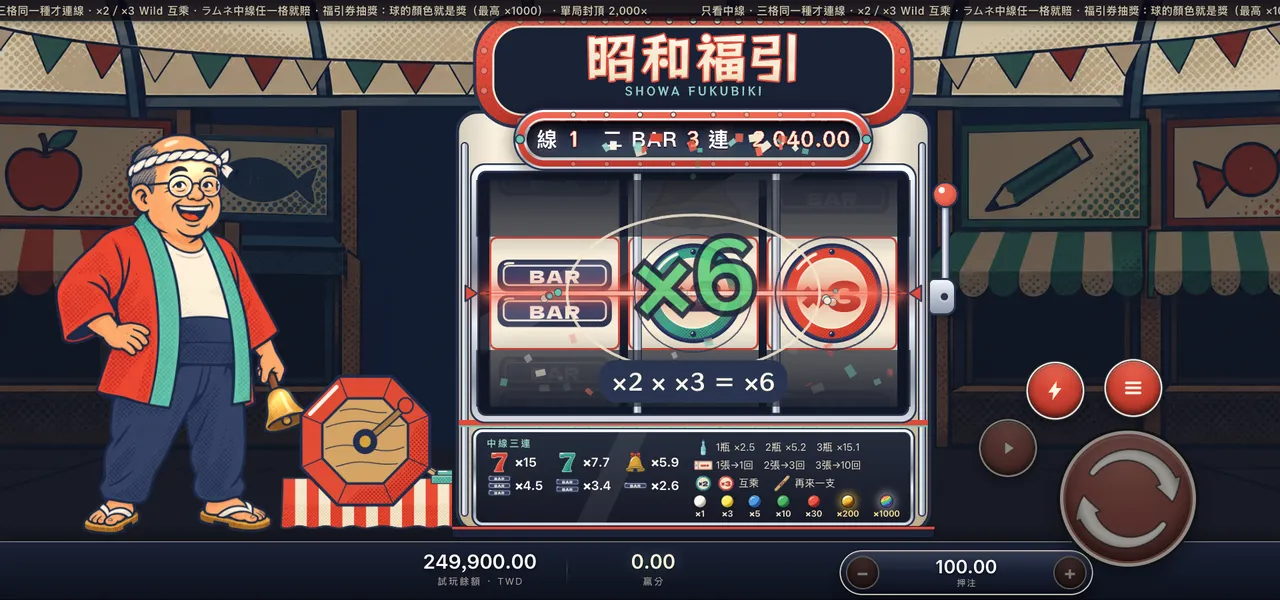
In the nostalgic decades of the Showa era, every December transformed neighborhood shopping streets into warm corridors of red-and-white triangular bunting. Beneath the covered arcade roof, the striped awnings of the greengrocer, the fishmonger, and the stationer stood side by side, their shop signs painted simply with an apple, a fish, and a pencil just like the old two-color handbills.
Every small household purchase all winter long came with a paper fukubiki lottery ticket tucked carefully into a coat pocket for the grand year-end sale. This classic three-reel machine captures that exact street corner at dusk, where every spin focuses purely on the single payline running straight across the center window. Every turn of the wooden crank fills the neighborhood shopping street with warm laughter and year-end anticipation.
II. Enamel Signs and Lamune Bottles
Framed inside the vintage reel window are timeless parlor icons—Red Sevens, brass bells, BARs, and winter mandarins—joined by weathered enamel multiplier signs bolted to the tin. Acting as wilds on the center line, these signs substitute for classic symbols and multiply against one another whenever more than one helps complete a win across the middle row. Cheerful brass bells ring out through the covered arcade as families gather around the red-draped prize table in winter coats.
Alongside them sit glass bottles of Lamune marble soda, which pay an instant prize whenever even a single bottle lands anywhere on the middle line without needing a full trio, and wooden winning popsicle sticks stamped with a free-encore mark that pays the current spin as usual and immediately grants a no-cost respin. Every turn of the wooden crank fills the neighborhood shopping street with warm laughter and year-end anticipation.
III. The Octagonal Wooden Drum
Whenever one, two, or three Lottery Tickets stop on the center line, the next spin steps up to the neighborhood prize table draped in red-and-white festival cloth. There stands the octagonal wooden garapon drum, with the merchant association chairman waiting brass bell in hand for you to grasp the wooden handle and turn the crank. Cheerful brass bells ring out through the covered arcade as families gather around the red-draped prize table in winter coats.
As the wooden drum rattles around on its stand, the honest preview window at the spout shows the ball color climbing step by step without ever teasing a high color and dropping back down to white. Where the window stops is the exact prize ball that rolls into the wooden tray—while a striped ball grants an immediate extra draw. Every turn of the wooden crank fills the neighborhood shopping street with warm laughter and year-end anticipation.
IV. Gold Balls and the Chairman’s Bell
Every ball that drops—from white, green, blue, and red up to the top prize tiers—pays a guaranteed multiple of the total bet. If you look closely at the cabinet and the street behind it, you will notice that not a single drop of gold paint is used anywhere on the machine: all the gold is saved for the Gold Ball.
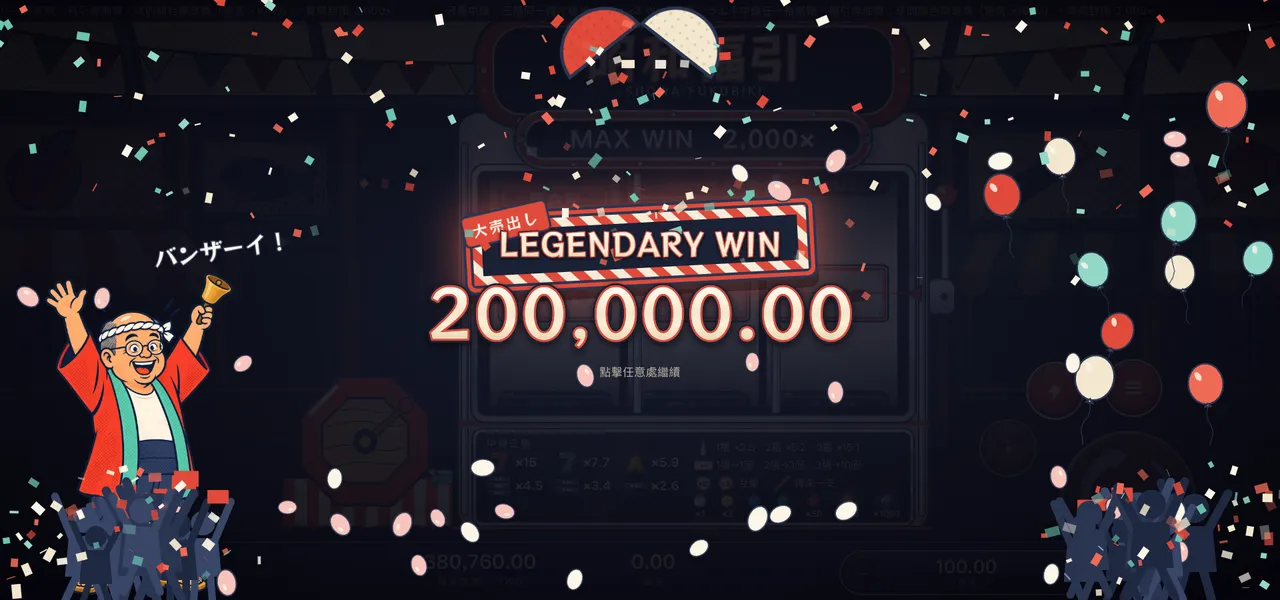
When a Gold Ball tumbles out into the wooden tray, the chairman freezes in astonishment before throwing both arms skyward in a banzai cheer; and when the rare Rainbow Ball appears, the entire shopping street rushes out under a shower of paper confetti and ringing bells to celebrate the year’s grandest prize. Every turn of the wooden crank fills the neighborhood shopping street with warm laughter and year-end anticipation.