





The story
Fiction and adapted settings written by Akitsora Gaming for this title, including invented dialogue and events. This is not a historical or folklore reference. The rules and specification tables define the gameplay and math.
Makimono wa, hirakareru made nan no jutsu ka wakaranai.
— Until it is opened, no one knows which art a scroll holds.
I. The house in the shade of the hill
The house has no name. By day it is a merchant's place in the shade of the hill, with a sun-bleached curtain over the door and someone working an abacus in the counting room. At night, the door to the room furthest inside is opened.
There are several hundred scrolls on the shelves. Every one is rolled tight and tied with a vermilion cord, and not one of them is labelled — a labelled scroll hands over the art itself on the day someone walks off with it. So a scroll has only two states: rolled, and nobody knows what it is; opened, and it has already been used.
II. The five talismans
An apprentice does not begin with the art. He begins with the paper.
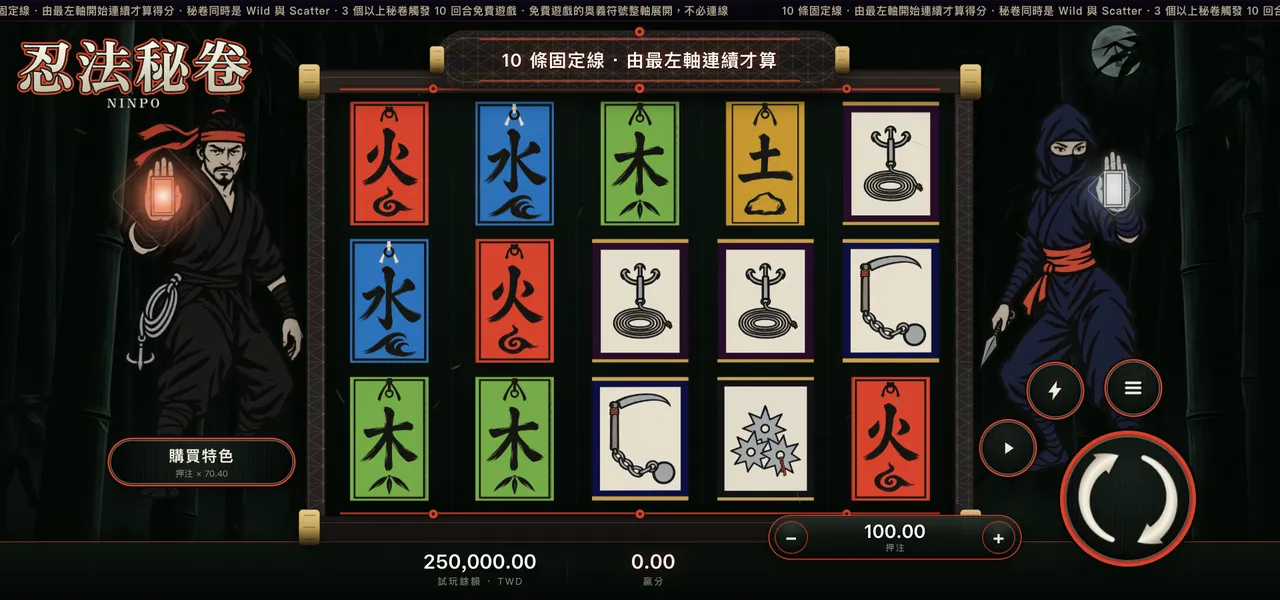
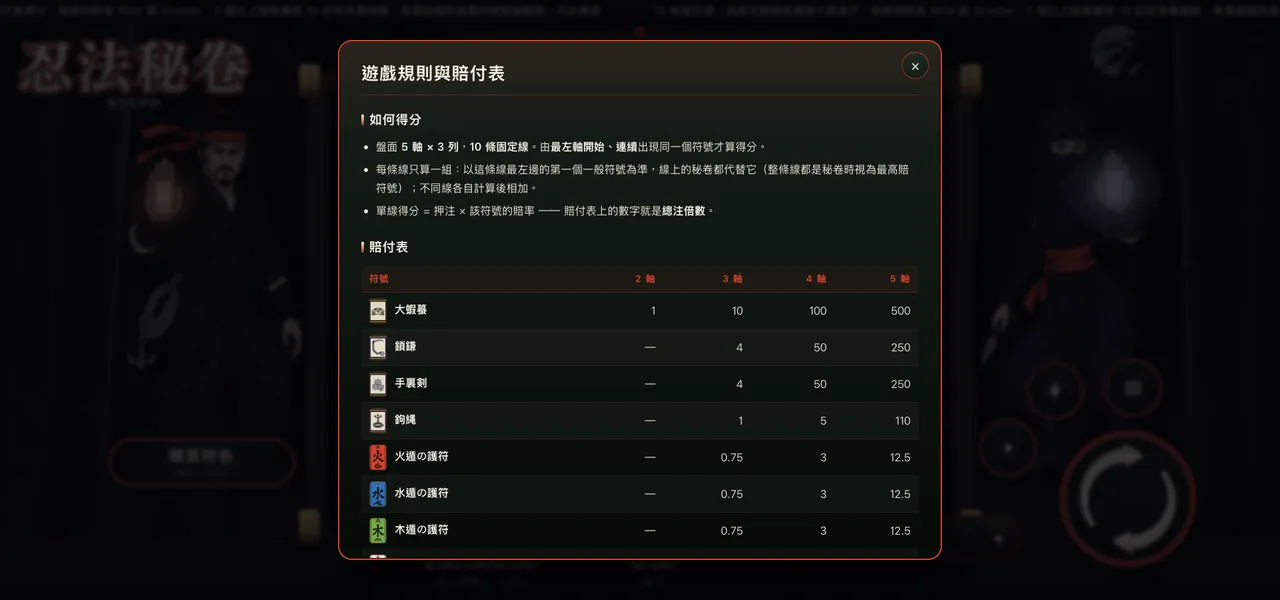
Fire, water, wood, metal, earth — five talismans, the same strip of paper, the same hole for the cord. Only the colour of the paper and the single character on its face are different. The master sets all five on their knees in an unlit room and does not let them sleep until they can tell one from another by touch. On the night it matters nobody is going to hold a lamp for you; the talisman is read with the pads of the fingers, off the grain of the paper.
None of the five is sorcery. Fire is knowing which way the wind runs. Water is knowing when the river rises. Wood is knowing which stand of bamboo will take a footstep without a sound. Metal is knowing the angle at which a blade throws light. Earth is knowing which patch of ground is hollow underneath. They were written down only because human memory cannot be trusted.
III. The head of the house and the kunoichi
Two people are standing in that room.
One is the head of the house: a man in his prime, black shinobi dress, headband pulled low, a grappling rope at his hip. One hand is raised with a talisman against the palm. When he holds still he looks like a length of timber against the wall.
The other is the kunoichi: young, dark indigo dress with a scarlet sash. One hand is raised, a talisman in that palm too; the other holds a kunai blade-down. Above the face cloth there is nothing but a pair of eyes — and she is the only one in the house who smiles first.
Both of them are human, and nothing on those shelves was anyone's by birth. Every art up there is something a person used one night, came back from, and then wrote down and rolled up — several hundred scrolls is that happening several hundred times. What the school actually passes on is not power. It is the price somebody already paid.
IV. The four old scrolls
Four scrolls on the shelf are older than the rest, the paper gone almost brown. They hang on the wall rather than sitting in a box — forget what they look like, the master says, and the school is finished.
The first is a giant toad, warts across its back, another scroll held in its mouth. Nobody knows what is written in the one it carries; every copyist since has drawn it exactly as it is, still rolled.
The second is the chain and sickle: a chain drawn taut between the blade and its weight, the ink thinning at the end of the stroke as though the chain were still swinging.
The third is three throwing stars stacked one on another, the lines cut so hard they show through the back of the paper.
The fourth is the grappling hook, claws up, the rope gathered into a coil. It is the first thing the school teaches and the last thing anyone truly learns: getting up there is half of it, getting back down is the other half.
V. The secret art
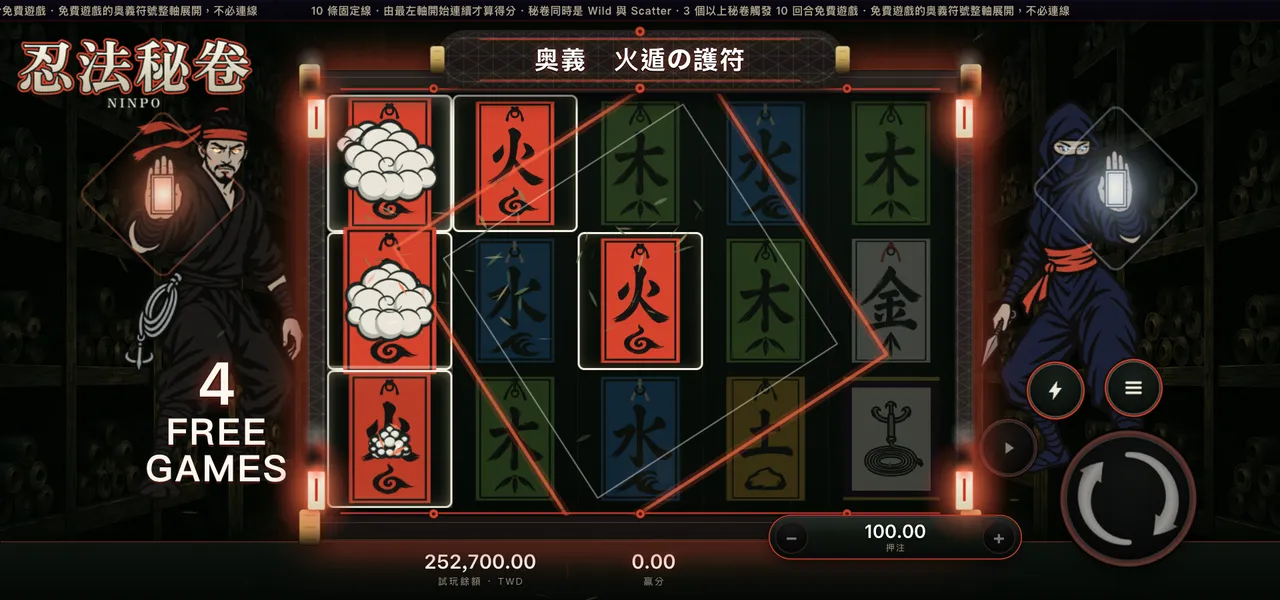
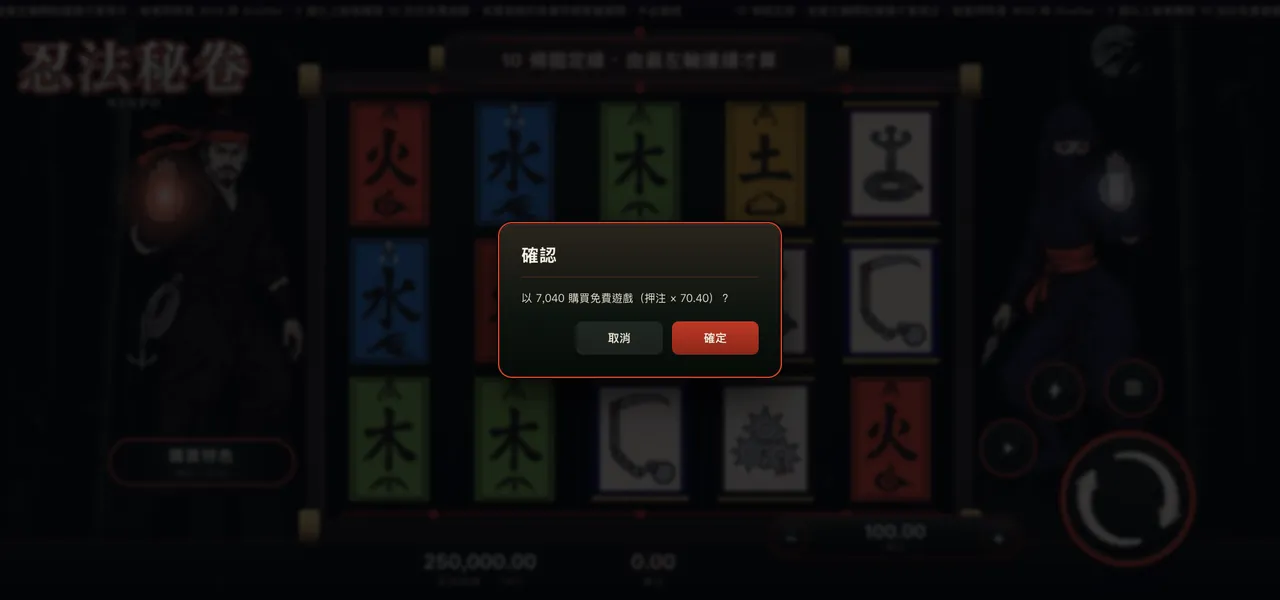
A few nights a year, scrolls on the shelf come loose by themselves. 3 of them at once and the night has begun — the next 10 rounds all belong to it.
The cord drops, the paper lies flat, and whichever figure surfaces on it is the art for that night. It cannot be chosen — if it could be chosen it would not be a secret art.
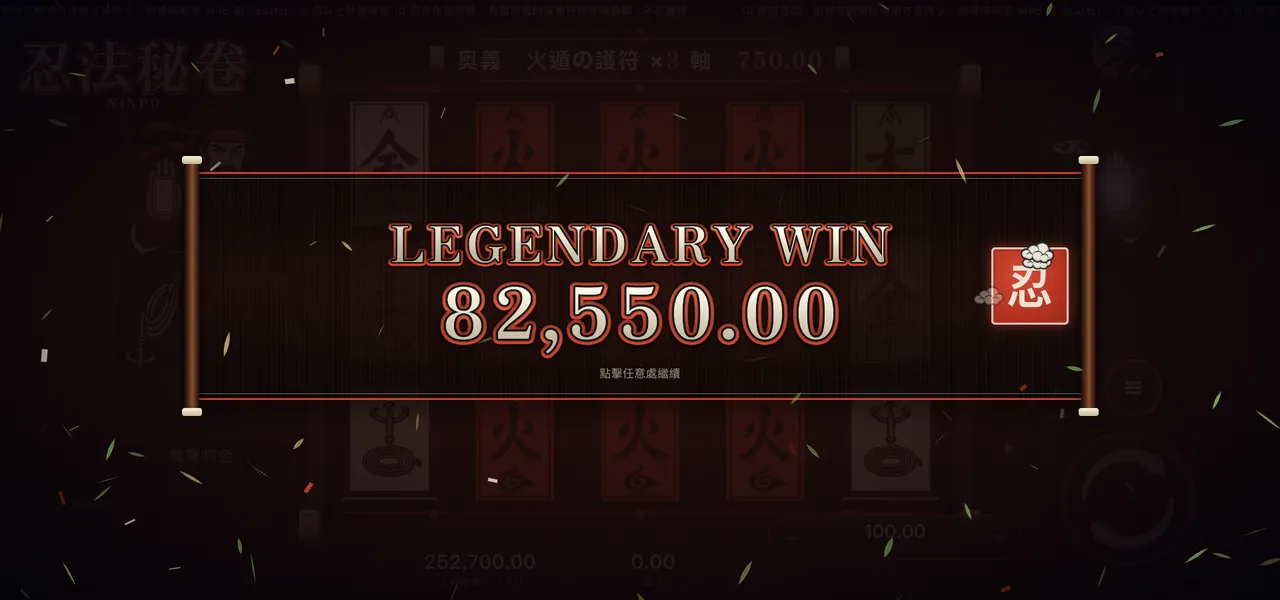
On any ordinary night this school works to form: 10 set routes, counted from the leftmost reel, and a single break anywhere along one ends it. Once the chosen art shows itself, form stops mattering. It does not have to line up, it does not have to stand next to anything: let it appear widely enough that night and the whole bamboo grove becomes that one art. If fire starts, all of it starts. If water rises, all of it rises. Only then do the people on the other side understand that they are not facing two of anything. They are facing an entire scroll.
VI. Shadow clones
Later still, a second scroll comes loose. Then a third — 3 arts in one night is all the paper will take. Gather 3 scrolls again and the night runs another 10 rounds, with every art already open still open.
Each one adds a shadow to the room. The shadows do exactly what the people do, and they do not tire, do not hesitate, do not lose half a beat when a bamboo leaf gives underfoot. By the end, nobody in that house can tell which one is the head of the house, which is the kunoichi, and which is only ink on paper.
Before dawn the paper rolls itself up and the cords tie themselves again. The house goes back to being a merchant's place in the shade of the hill, with someone working an abacus in the counting room.
VII. Into the bamboo
Somebody once asked the head of the house which art in the scrolls was the strongest.
He thought about it and said: the one that leaves them certain nothing happened at all.
Then he blew out the lamp. What was left in the room was the smell of paper, and the sound of the bamboo turning over in the wind.