






The story
Fiction and adapted settings written by Akitsora Gaming for this title, including invented dialogue and events. This is not a historical or folklore reference. The rules and specification tables define the gameplay and math.
Snow is at its quietest not while it falls, but in the hour after it stops.
— Something they say on the pass
I. The hut at the pass
The snow came early that winter. Two woodcutters were caught by a blizzard on the mountain road, and it was fully dark before they were over the pass, so they took shelter in an empty hut beside the road. There was no fire inside — two straw mats, and a door that would not shut properly. The older man fell asleep at once. The younger did not. He lay listening to the snow strike the boards, one beat and then another, as though something outside were keeping count.
Near midnight, the door opened.
No wind came in with it. No snow crossed the threshold. What came in was a woman in white, walking slowly, barefoot, and the boards did not creak under her. She knelt beside the sleeping man, bent over him, and breathed out — and the breath was white, and it settled on his face like a thin coat of frost.
Then she turned her head and looked at the one who was awake.
Tonight I let you go, she said. But you must never speak of tonight to anyone. On the day you say it aloud, I will come back.
When the door closed, the hut was very slightly warmer than before she entered. The young woodcutter's name was Minokichi, and he was nineteen. He is the only person who ever walked down from that pass and told anyone what happened there.
II. The red at the collar
People who paint her always paint her white. White silk, hair loose to the waist, a hem that spreads out into snow. There is exactly one red thing about her: the inner collar turned back at her throat.
That is the scarlet under-robe worn beneath white shiromuku. In Japan the wedding robe and the mourning robe are the same white; only the layer underneath tells them apart. So no one who meets her knows which occasion this is until she is close.
She has not come for anyone's life. She is what the snow means — snow hates nobody, snow simply falls, and whoever it falls on is whoever it falls on. She looks like a woman only because a thing that lives in the mountains must first take a human shape before people can remember it.
III. What else lives up there
She is not alone on the pass.
The red-crowned crane comes through on the coldest days, neck folded back into a curve, wingtips dark. It does not settle on the snow so much as settle in the mind — nothing bad happens in a year when you have seen a crane. Even people who believe in nothing will say that much.
The kamaitachi travels inside a whirlwind. The old people insist there are three of them: the first knocks you down, the second opens the cut with its sickles, the third closes it with ointment. That is why the wound neither bleeds nor hurts — you find it later, at home, when you take off your straw cape. Mountain people are not afraid of the weasel. They are afraid of a gust that arrives too quietly.
The yuki-warashi are the children who come down with the snow: sedge hats, straw capes, cheeks red with cold, a rabbit built out of snow held in their arms. You can hear them laughing across a field and find no footprints. On the day the snow melts they are gone, and nobody asks where, because everyone who would ask already knows.
IV. The colours winter keeps
A winter mountain is not colourless. It simply puts its colours away and shows you one at a time.
The camellia is the only red bold enough to open in snow. And when it goes, it does not shed petal by petal — the whole flower drops at once. Warrior families thought that unlucky. Mountain people thought it was the only honest way to do it.
The snow rabbit is built by children: a handful of packed snow, two nandina leaves for ears, two red berries for eyes. It sits under the eaves all night and collapses before dawn, and the next day they build another.
The temari ball is no use until spring, so it stays at the bottom of the chest all winter while a mother winds coloured thread around it by lamplight, night after night, so that there will be something to play with on the day the snow finally goes.
The snow crystal was the last of them to be drawn. In the Edo period a provincial lord spent his winters at a microscope, catching snow on black lacquer and drawing it flake by flake for twenty years. He recorded more than 180 forms, every one of them six-sided, and no two the same, and published them as Sekka Zusetsu and its sequel. After that, snow crystals began appearing on kimono, on lacquerware, on family crests — a pattern one man bought with twenty winters.
The kokeshi doll is not a decoration from the snow country; it is a child of it. Northern woodturners had no fields to work in winter, so they turned a round head on a plain cylinder and painted red flowers on it. With one of those in the house, the winter was not quite so long.
V. The six-petalled flower in her palm
When she means to act she does not raise a sleeve or say a word. She simply lifts one hand to her chest, opens the palm, and breathes onto it.
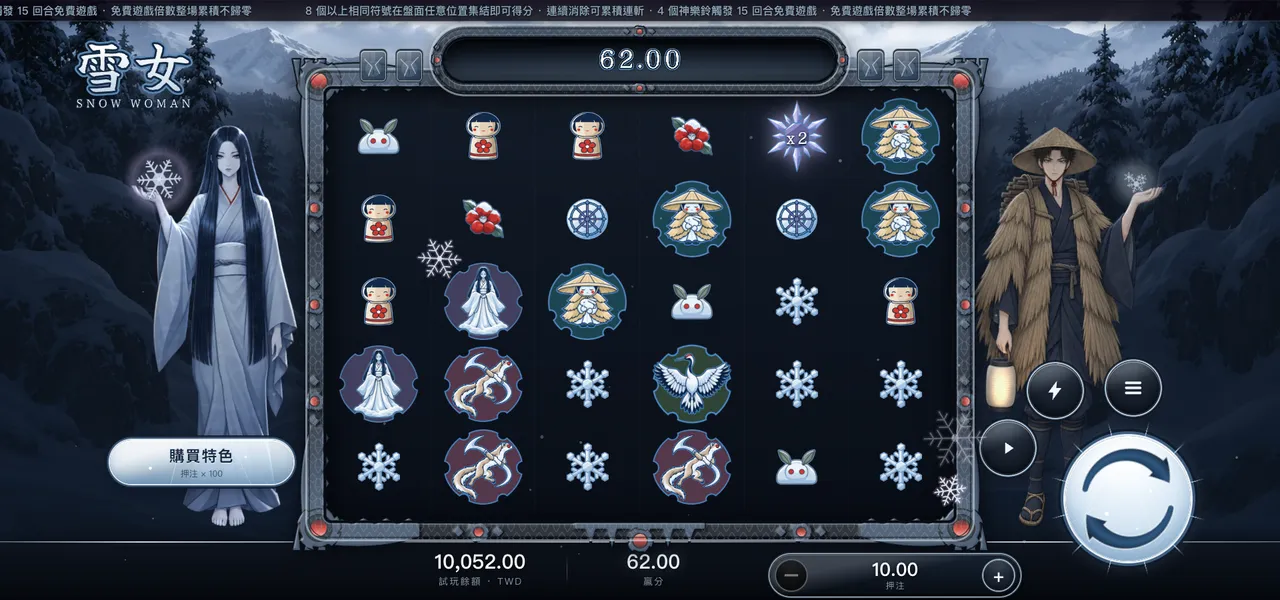
The breath freezes into a flower with six points — rikka, the old word for snow. Each one carries a number at its centre, and that number is what the flower weighs. Every one on the board when a win lands counts, and the more of them there are, the heavier that single moment becomes (base game ×2 to ×20).
But on an ordinary night the flower melts where it touches. It counts only for the instant of its falling — what you catch, you have caught; what you miss runs away as meltwater into a crack in the stone, and the road keeps nothing.
VI. How a slide starts
Snow in the mountains never comes down one piece at a time.
A cedar branch bent all night finally gives, and its load drops onto the branch below; that one gives too, and then the next, and the next, until an entire stand of trees has put down everything it was carrying — with a sound so low it could be someone moving furniture a long way off.
Whatever falls is replaced from above at once. The snow has not stopped; a gap never stays a gap. That is why one slide is so often followed by a second and a third. Anyone who walks these roads knows the first drop is not the dangerous part. The dangerous part is whether anything follows it.
VII. The bells in the ice
At the highest point of the pass stands a small shrine nobody looks after. Half the posts have rotted, the sacred rope went years ago, and the only thing still hanging at the front is a row of kagura suzu — strings of shrine bells, each sealed in ice, silent in any wind.
Minokichi's lantern found them that night as he passed. He said afterwards that the bells did not look trapped in the ice. They looked as if they had gone in there to hide.
The story goes like this. If ever the ice releases 4 strings of bells, they will ring — and once they ring, the pass turns to whiteout. For the next 15 rounds there is nothing between earth and sky but white: no cedars, no road, no way of telling how far you have walked.
And in the whiteout one thing is different. The flowers do not melt. Every one she breathes out settles on the last, one on two on ten, nothing given back for the whole of it (×2 to ×500), until the final flower has come down. Which is why, inside a whiteout, the heaviest moment is never the first one.
And if the snow still will not stop, the ice gives up 3 more strings, the pass blows for 5 rounds longer, and not one of the flowers already gathered is lost.
VIII. O-Yuki
Minokichi came down off the mountain and told nobody.
The following winter he met a young woman travelling alone on the same road. Her name was O-Yuki. She said she had no family left and was going to Edo to look for work. He brought her in out of the snow, and before the year was out they were married.
She did not age. The neighbours said, privately, that a woman who had borne ten children ought not to look like that. But she was kind and her hands were clever, and after a few years the talk stopped.
Many years later, on an evening when the children were asleep, she sat sewing by the lamp. The light caught the side of her lowered face, and Minokichi watched her for a while and then said:
Looking at you just now reminded me of something. When I was nineteen I saw a woman in a hut up at the pass. She had your face exactly — white in a way no living person is.
The needle stopped. She set down her sewing, stood, and crossed the room to him.
That was me, she said. I asked you never to say it. You agreed.
He waited. Outside there was no wind at all.
Tonight was to have been the night, she said. But the children are asleep in the next room. Be good to them. If you are not, I will know.
She came apart from the hem upward, into a white mist that ran along the floor and out through the smoke hole above the hearth. The lamp flickered once and did not go out.
Nobody saw O-Yuki again. And nobody ever heard Minokichi speak of it again either — he had already said it once.
IX. The pass today
The pass is still there. It closes in winter and it is walkable in summer, and the little shrine by the road still has nobody looking after it.
People who cross it say the snow stops there very abruptly: blowing hard one moment, and the next completely still — still enough to hear yourself breathe.
The old people up there offer only one piece of advice. At a moment like that, say nothing.