
AKITSORA GAMING

Hyakunin Isshu

New Year in the tatami room: the reader calls the first lines, and the card is on the board.

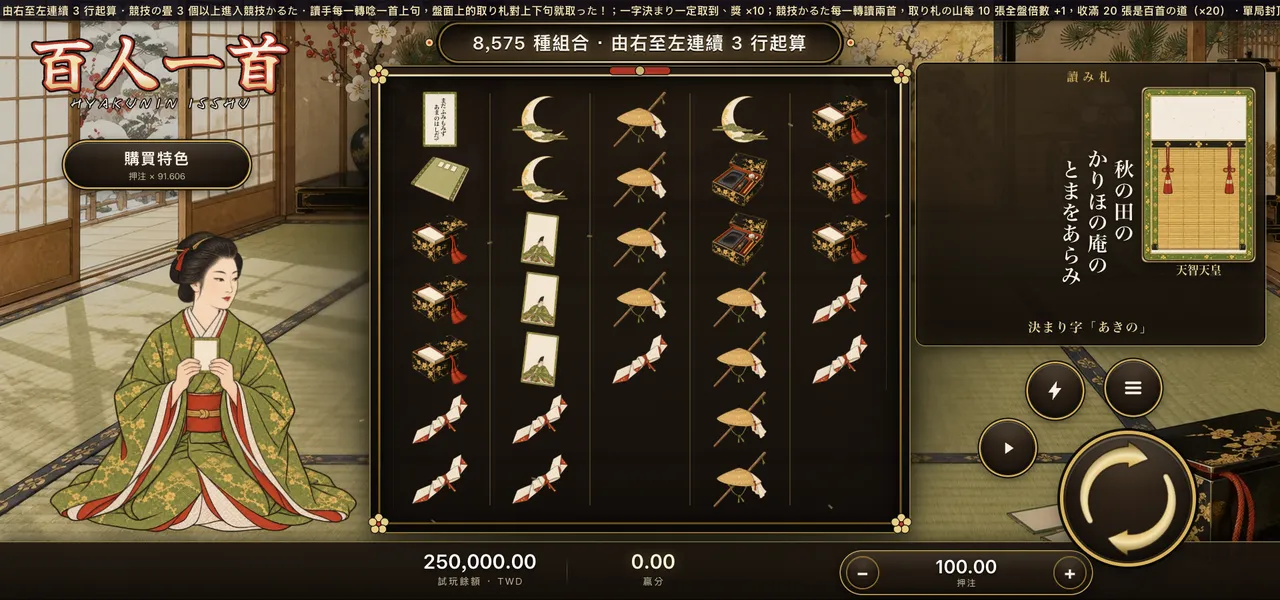
Hyakunin Isshu lays its board out as a five-line tanka (5-7-5-7-7), read right to left, with 8575 ways. Grab the card that matches the reader's poem; one-syllable poems always land for ×10.

Demo play uses virtual credits with no monetary value.

RTP
96.52%
Volatility
High10.66
Max win
10,000× bet
Bonus buy
91.606× bet

In-game screens

Captured straight from the running game — real boards, real wins.

Hyakunin Isshu — The tatami room
The tatami roomA five-line tanka board read right to left; the reader sits on the left and the reading card at the top right shows this spin's poet.
Hyakunin Isshu — Grabbed
GrabbedA card on the board matches the poem being read, and a hand slaps it down.
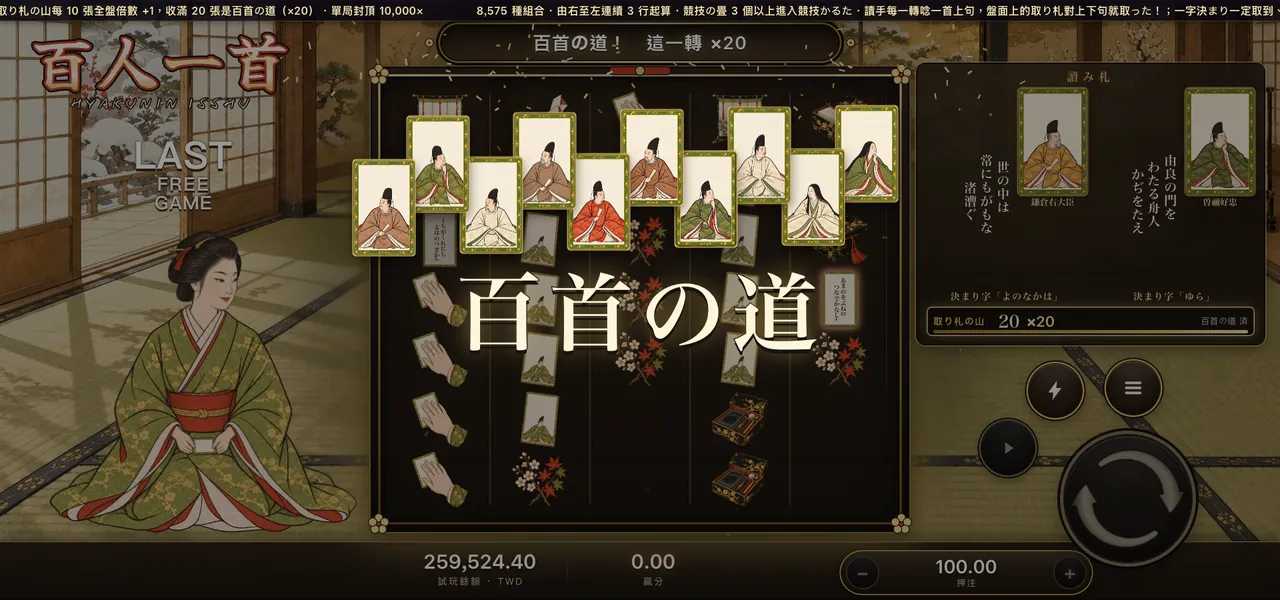
Hyakunin Isshu — Competition karuta
Competition karutaTwo poems per spin onto the card pile; the spin that reaches 20 cards pays ×20.
Hyakunin Isshu — Big win
Big winA single round is capped at 10,000× the bet.
Hyakunin Isshu — Bonus buy
Bonus buy×91.606 to start Competition karuta (10 spins).
Hyakunin Isshu — In-game paytable
In-game paytableThe RGS supplies the hundred poems, their deciding syllables and the prizes; this page reads the same game definition.

Specification

TypeA five-line tanka board (5-7-5-7-7 cells), 8575 ways (pays from 3 consecutive lines starting at the rightmost), with a reader calling poems and grabbing cards
Return to player (RTP)96.52%
Bonus buy RTP96.52%
VolatilityHigh (10.66)
Hit rate33.48%
Rounds winning ≥ 1× bet7.67%
Max win per round10,000× bet
Free spins (Competition karuta) frequency≈ 1 in 188.82 spins
RTP verificationExact solution: base game and feature computed exactly (not sampled); the max-win cap's 0.0001 percentage points are estimated by simulation; RTP 96.5246%

Game math specifications and the paytable are read at build time from the definitions shared with the server code. See Math version for the configuration shown; confirm any other version or operator-specific settings separately.

How wins work

  • The board follows the five lines of a tanka: 5 lines (5-7-5-7-7 cells) and 8575 ways, with no fixed paylines.
  • Matching symbols on 3 or more consecutive lines starting from the rightmost pay.
  • The karuta hand is wild and substitutes for regular symbols (not for the tatami or the grabbing cards); it never lands on the rightmost line.
  • Tatami do not pay on ways: 3 or more anywhere start Competition karuta (free spins).

Paytable

Values are total-bet multiples per way: a win = total bet × table value × the product of matching symbols on each line. The karuta hand (wild) counts as a matching symbol. Ways start from the rightmost line (the opening line of the poem). Grabbed cards pay separately by the length of their deciding syllables. The paytable is the same data shown in game.

Symbol3 lines4 lines5 lines
Karuta boxHigh-pay 0.0280.0840.21
Reading cardHigh-pay 0.0220.0670.168
Inkstone boxHigh-pay 0.0180.0530.133
Kicho screenHigh-pay 0.0140.0420.105
Love letterLow-pay 0.0060.0140.035
JourneyLow-pay 0.0050.0120.029
Parting moonLow-pay 0.0040.010.025
Four seasonsLow-pay 0.0040.0080.021

Special symbols

Karuta hand

Wild. Substitutes for regular symbols but not for the tatami or the grabbing cards; never on the rightmost line.

Competition tatami

Scatter. No connection required: 3 or more start Competition karuta; 3 or more during the bonus add 3 spins.

Grabbing card

Carries the closing lines of a poem. If it is the poem being read you grab it for 5× to 25×; otherwise it is a decoy.

Features

The reader and the grabbing cards

At the start of every spin the reader calls the first three lines of one of the hundred poems (the reading card at the top right shows that poet). Each grabbing card on the board carries the closing lines of some poem: if it is the poem being read, you grab it and it pays by the length of its deciding syllables: 2 kana 5×, 3 kana 7×, 4 kana 10×, 5 kana 15×, 6 kana 25×. Any other card is a decoy.

One-syllable poems

Seven poems are decided by their very first syllable (mu, su, me, fu, sa, ho, se). When the reader calls one of them in the base game, its card always lands and pays 5× × 10 = 50×.

Competition karuta

3/4/5 tatami award 10/12/15 spins; 3 or more during the bonus add 3 spins. Two poems are read every spin: one-syllable poems are grabbed instantly (2×), the others are matched to the cards on the board (1× to 4×).

The card pile and the Road of a Hundred Poems

Grabbed cards go onto the card pile, and every 10 cards add +1 to the whole-board multiplier (no limit). Cards are piled first, then the spin is multiplied. The spin that first brings the pile to 20 cards is the Road of a Hundred Poems: that spin pays ×20 (once per bonus), and the multiplier keeps climbing afterwards.

Volatility and positioning

Volatility 10.66. The 33.48% hit rate counts any winning round; 7.67% of all rounds return at least the stake. The base game carries about 50% of the RTP, with one-syllable poems as its instant big moment; Competition karuta comes about once every 188.82 spins. A single round is capped at 10,000× the bet and ends when it hits the cap. This describes the product's positioning and does not guarantee any single session.

Bonus buy

Pay 91.606× the bet to start Competition karuta (10 spins). The price follows the expected value of that purchase route (bonus-buy RTP 96.52%) and is calibrated separately from regular play.

Technical

Game codeaki_hyakunin
Math versionhy1
TechnologyHTML5, no plug-in; one client for desktop and mobile
ViewportLandscape with proportional scaling
In-game languageTraditional Chinese (additional languages on request)
CurrenciesTWD (others can be registered on request)
IntegrationTransfer wallet (Operator API v3), launch-token redirect

Sources & verification scope

This product specification is written and maintained by its developer, Akitsora Gaming (AKI電子 in Taiwan). Measurement methods and sample information for RTP, volatility and hit rate appear in the specification table. Sampled results have uncertainty; RTP describes long-run return, not an individual player or session outcome.

Internal simulations and tests are not independent certification. We do not currently hold GLI or BMM certification reports. Supply to a market requiring third-party certification depends on completing its requirements.

See slot game development and supply for integration and supply scope, About us for development and content responsibility, or contact us for a math summary, version confirmation or a correction to this page.

The story

Fiction and adapted settings written by Akitsora Gaming for this title, including invented dialogue and events. This is not a historical or folklore reference. The rules and specification tables define the gameplay and math.

New Year in the tatami hall, a box of poem cards before a gold screen.
At the reader's very first syllable, a hand is already sweeping across the mat.

I. One Hundred Poems in Vertical Lines

In the early Kamakura period, the court poet Fujiwara no Teika selected one hundred classical waka—one verse each from a hundred master poets—to adorn the walls of his villa at Mount Ogura. Centuries later those verses became Hyakunin Isshu karuta: painted reading cards bearing the poet's portrait and opening lines, paired with kana grabbing cards spread across the tatami.

True to classical Japanese verse, the game board is arranged in the five-seven-five-seven-seven rhythm of a five-line tanka poem and reads from the rightmost line toward the left, with the swift karuta hand acting as a wild symbol along the way to join consecutive lines across the mat.

II. The Reader's Voice and the Matching Card

At the start of every spin, the reader intones the opening phrase of one poem from the hundred-verse anthology while its poet appears on the reading card at the top right of the screen. Meanwhile, wooden-edged grabbing cards inscribed with closing verses in flowing kana script land across the vertical lines.

If a card on the board carries the closing verse of the exact poem being chanted, the player's hand snaps it up with a crisp slap across the woven mat, awarding an instant prize scaled by the poem's deciding syllables while non-matching cards remain harmless decoys.

III. Seven Poems Decided in a Single Sound

In competitive karuta, players memorize the exact syllable at which each opening verse becomes unique among all one hundred poems. Seven famous verses—remembered by the syllables mu, su, me, fu, sa, ho, and se—are one-syllable poems whose identity is certain the instant the reader's lips form the very first sound.

Whenever the reader calls one of those seven one-syllable poems in the base game, its matching grabbing card always lands on the board and is struck immediately in a lightning-fast reflex take, multiplying its prize for the biggest instant moment in regular play before the next verse begins.

IV. The Card Pile and the Hundred-Poem Road

Landing enough woven competition tatami scatters starts the Competition karuta bonus, where the reader chants two poems on every single spin. Every card you grab is stacked onto your card pile beside the mat, and every few cards added raises the whole-board multiplier for the rest of the match without limit.

Stacking enough cards in a single match unlocks the Road of a Hundred Poems, multiplying that entire spin once more while the pile keeps growing afterwards. It is the game's theme, not a promise: the art of karuta belongs to poetic tradition, while every spin's outcome is still decided by the RGS random number generator.

Want to spin Hyakunin Isshu yourself?

The demo needs no account — click and spin. For integration docs, the math summary or sandbox access, send us an email.

Demo play uses virtual credits with no monetary value.