





The story
Fiction and adapted settings written by Akitsora Gaming for this title, including invented dialogue and events. This is not a historical or folklore reference. The rules and specification tables define the gameplay and math.
Afternoon sunlight slants through the paper screen onto a low wooden table.
Fold a sheet of washi, make a single cut, and unfold a symmetrical family crest.
I. The Edo Art of Crest Cutting
During the Edo period, townsfolk and children delighted in a quiet pastime called monkiri—the art of cutting family crests from paper. Without ink or brush, a craftsperson simply took a square of dyed handmade washi, folded it neatly, snipped a few shapes with iron blades, and unfolded a crisp heraldic emblem.
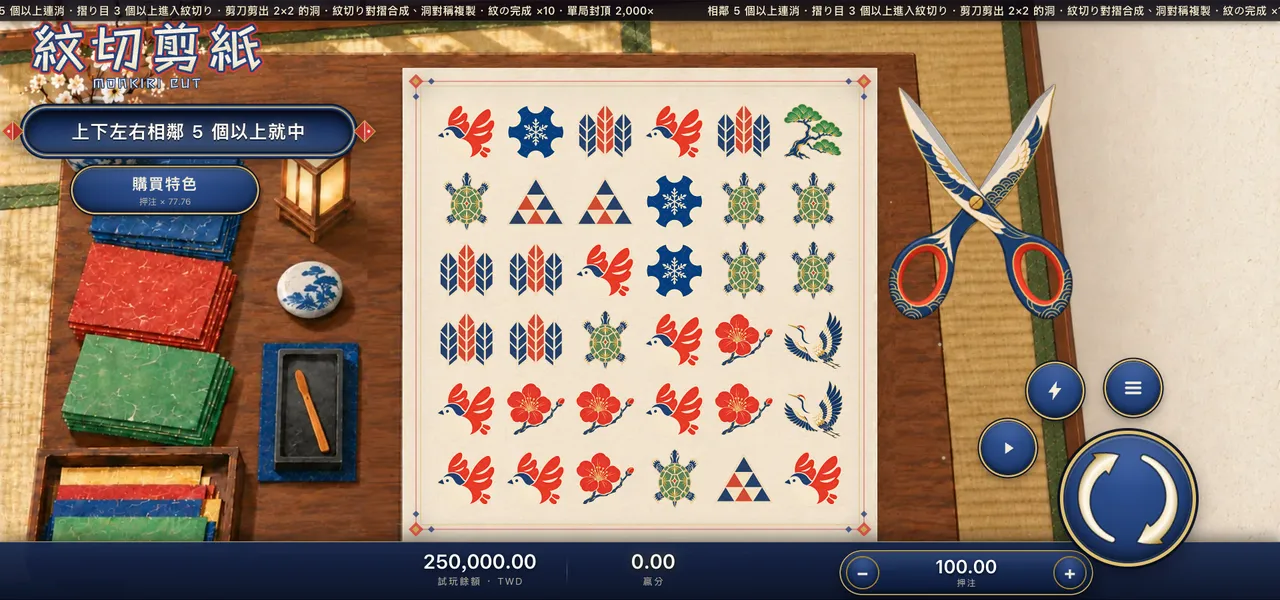
Cranes, tortoises, pine diamonds, plum blossoms, scales, arrow feathers, plovers, and snow rings all emerged from simple geometry. The square grid of the game is that sheet of washi laid flat on a walnut table, where matching crests touching orthogonally form clusters and clear.
II. Iron Scissors and Wooden Grain
Spinning among the printed crests are pairs of traditional U-shaped iron scissors. Whether they land on the initial drop or fall in during a cascade, the spring blades immediately snip a two-by-two square hole out of the paper with their own cell as the corner.
Through those cut-out holes the warm wood grain of the low table shows through clearly. Every hole cell acts as a wild symbol that joins adjacent crests into larger clusters across the sheet, vanishing cleanly with the paper scraps once it has helped complete a win.
III. Folding Along the Crease
Faint white creases also appear across the sheet, and gathering enough of them once the cascades settle begins the Kirigami free spins. Every spin in the bonus starts with a fresh sheet of washi that folds before the symbols are evaluated—left to right, top to bottom, or quartered in a four-fold.
Wherever two cells folded on top of one another hold the exact same symbol when the grid stops, both overlapping cells upgrade one tier from a simple pattern into a formal crest, or from a family crest into the top-paying gold crest.
IV. Mirrored Cuts and the Finished Crest
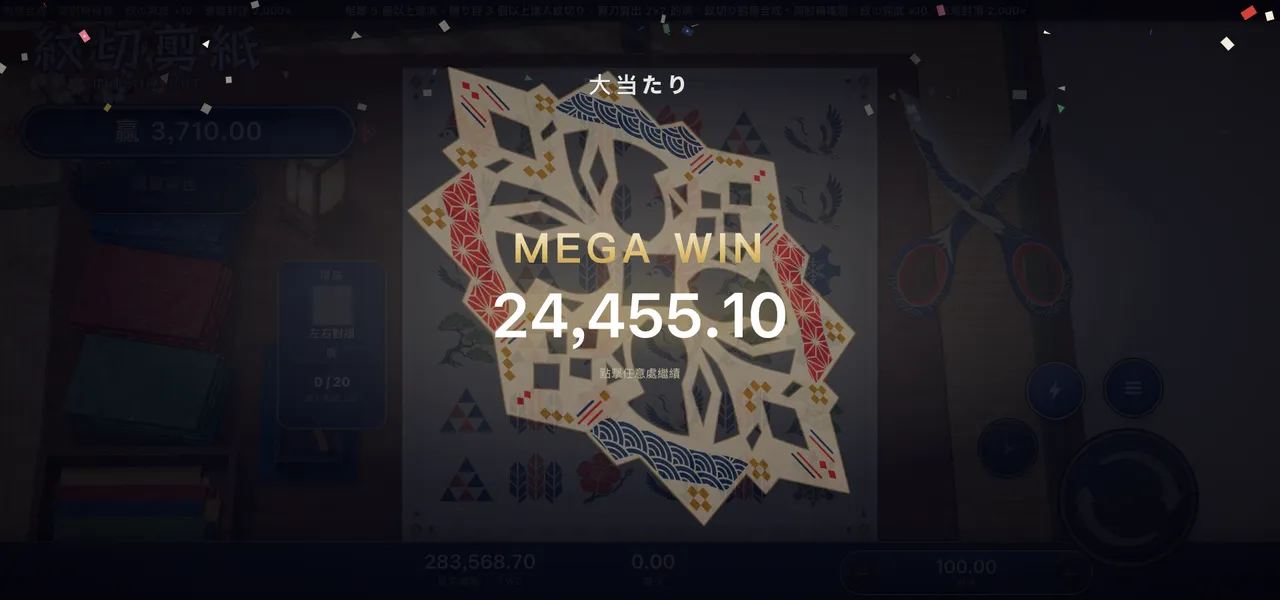
Cutting folded paper is where the magic of monkiri truly shines: in Kirigami, every hole snipped by the scissors is automatically mirrored across the active fold lines, so a single pair of scissors on a four-fold sheet can open up four symmetrical windows of wilds at once.
If enough hole cells lie open across the paper when the sheet unfolds, the crest is complete and the entire spin's payout is multiplied before the cascades even begin. It is the game's theme, not a promise: folded paper and heraldic crests are traditional craft, while every spin's outcome is still decided by the RGS random number generator.